
Investing in the digital age: Robo-advisers vs. traditional advisers
Should I use a robo-adviser or a financial adviser in Singapore? A practical comparison.
Last updated on 14 September 2026
Key takeaways
A robo-adviser is a digital platform that uses algorithms to build and manage an investment portfolio for you, based on your goals and risk profile.
Robo-advisers in Singapore are regulated by the Monetary Authority of Singapore (MAS) and typically offer lower fees and lower minimum investments than traditional wealth managers.
They work best for straightforward financial situations. Multi-faceted needs such as business ownership, inheritance and estate planning usually require a human adviser.
What is a robo-adviser?
A robo-adviser is a digital investment platform that uses computer algorithms to manage your money. You answer a series of questions about your financial goals, investment timeline, and risk tolerance.
The algorithm then builds a portfolio — typically using a mix of investment funds, such as unit trusts or Exchange-Traded Funds (ETFs) — and manages it on your behalf. This includes automatically rebalancing the portfolio when it drifts from its target allocation.
In other words, it does much of what a traditional investment adviser does, but through software rather than a human relationship, generally at a lower cost and with a lower minimum investment.
How robo-advisers work in Singapore
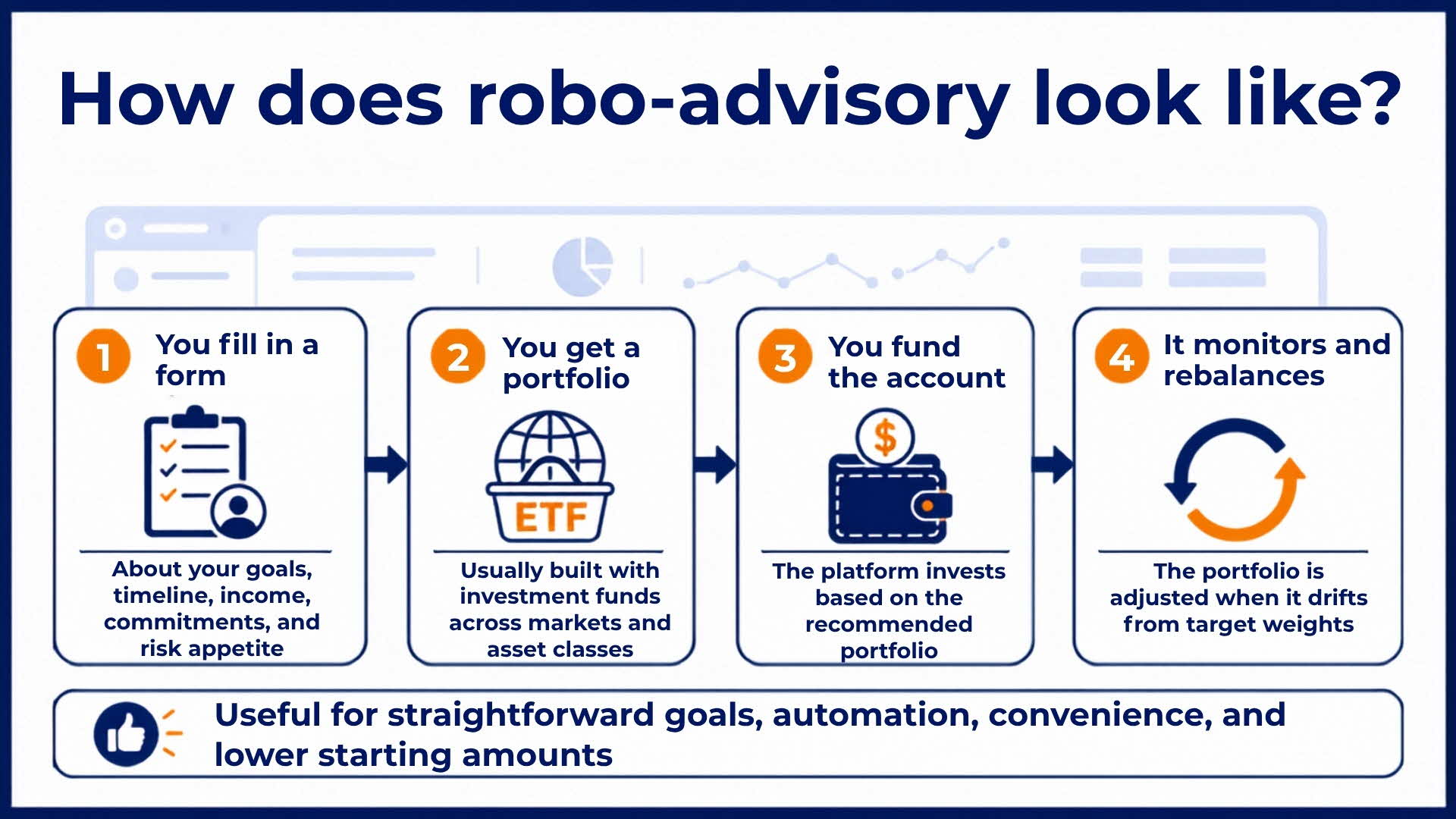
Several MAS-licensed robo-advisers operate in Singapore. While they differ in their specific offerings, most follow a similar process:
You complete an online questionnaire covering your investment goals, time horizon, income, financial commitments, and how you would react to a significant portfolio loss.
The platform recommends a portfolio, typically a mix of investment funds across different asset classes and geographies.
You fund the account, and the platform invests your money according to the recommended portfolio.
The platform monitors and rebalances the portfolio automatically when it drifts from its target weights. You do not need to do anything.
You can check your portfolio, add or withdraw funds, and adjust your goals through the platform’s app or website.
Most Singapore robo-advisers allow you to start with as little as $1 and offer no minimum monthly contribution. Some also offer thematic portfolio options, CPF Investment Scheme (CPFIS) investing, and Supplementary Retirement Scheme (SRS) account integration.
How robo-advisers compare to traditional advisers
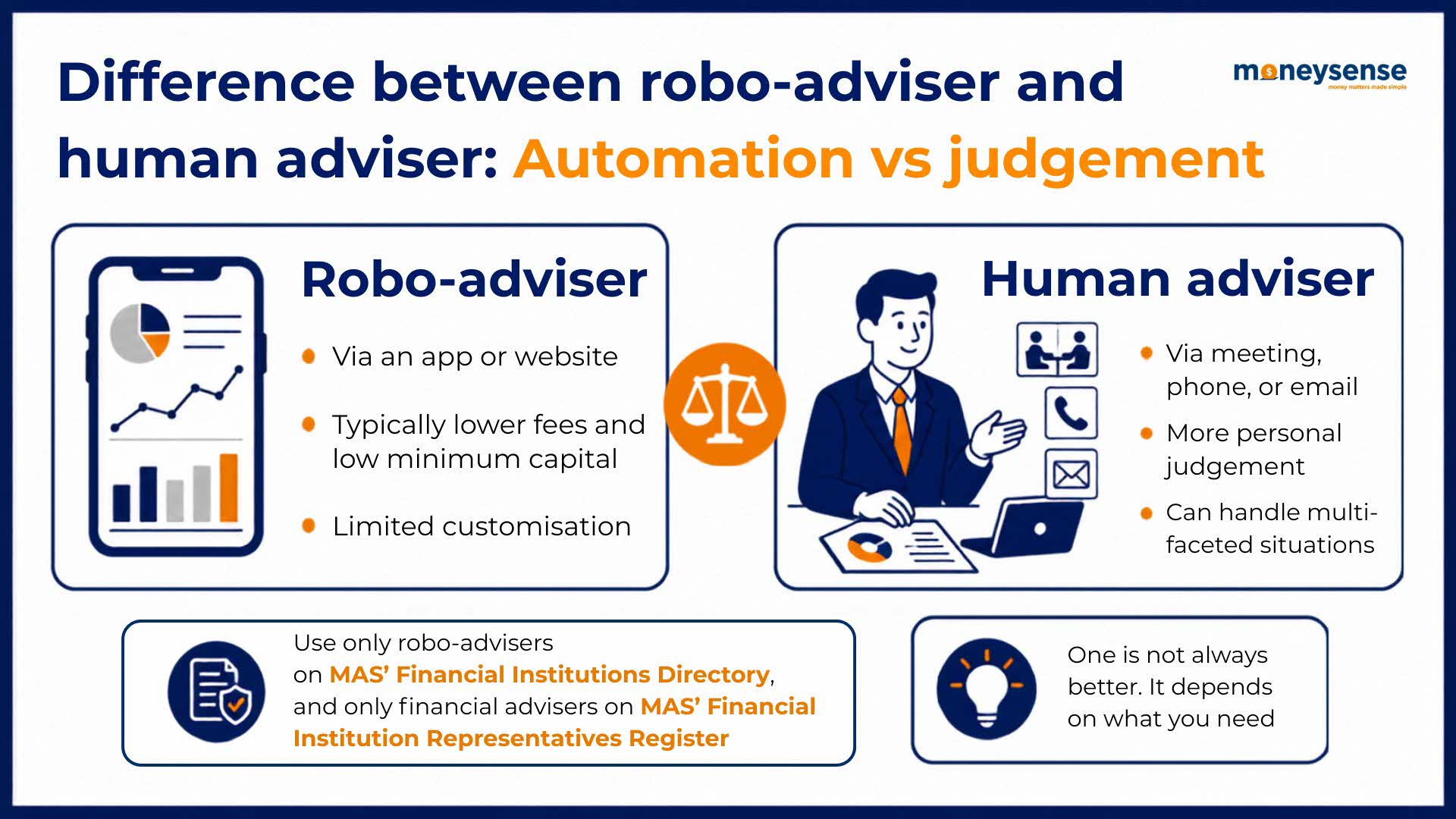
Comparing robo-advisers to human financial advisers
| Robo-adviser | Human financial adviser |
How you interact | Entirely digital: app or website | In-person meetings, phone, or email |
Cost | Typically a percentage of the assets under management per annum, plus underlying investment fund fees | Sales charges plus ongoing adviser fees or trailer fees; typically higher total cost |
Minimum investment | Often as low as $1 or $100 | Varies |
Portfolio type | Diversified ETF portfolios; limited customisation | Can be fully customised to your specific situation |
Personalisation | Based on responses questionnaire; limited nuance | Financial adviser conducts a full Financial Needs Analysis which can account for more personalised, specific circumstances |
Suitable for | Straightforward goals like retirement savings, regular investing, building a diversified portfolio with low fees | Multi-faceted situations such as business ownership, inheritance, estate planning, integrated insurance and investment needs |
Regulated by MAS? | Yes — check MAS' Financial Institutions Directory (opens in new tab) | Yes — check MAS' Financial Institution Representatives Register (opens in new tab) |
When a robo-adviser may fit
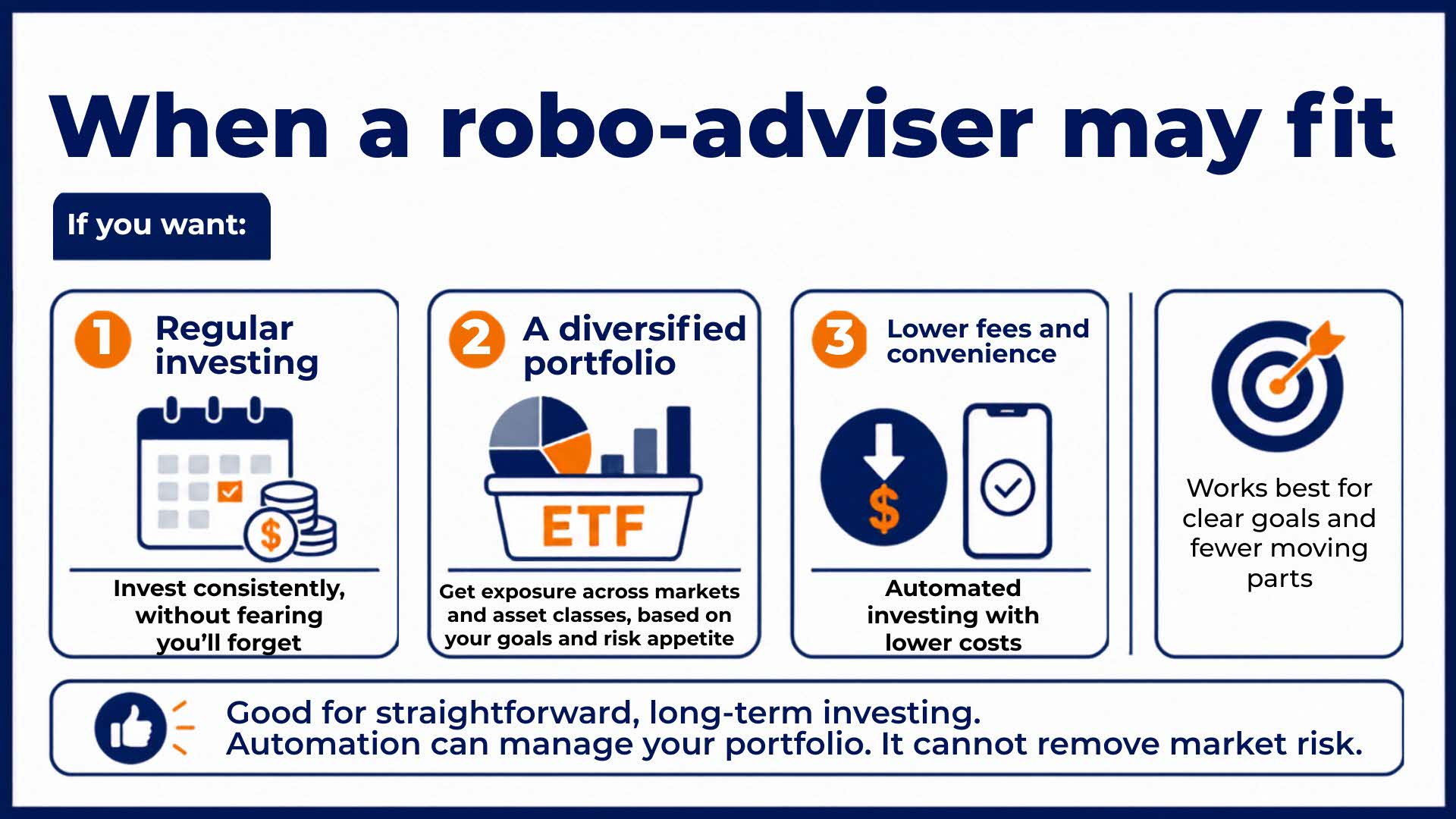
Robo-advisers are likely a good fit if:
You are starting out and want a low-cost, diversified portfolio without needing to select individual stocks or ETFs.
Your financial situation is relatively straightforward: You are employed, have a clear savings goal, and do not have complex tax or estate planning needs.
You value convenience: You want to invest regularly with minimal ongoing decision-making.
You want lower fees: Over 20–30 years, a lower annual fee can make a substantial difference to your total returns due to compounding.
You prefer transparency: Most robo-advisers show you exactly what you own, in real time.
When a human adviser may be more appropriate
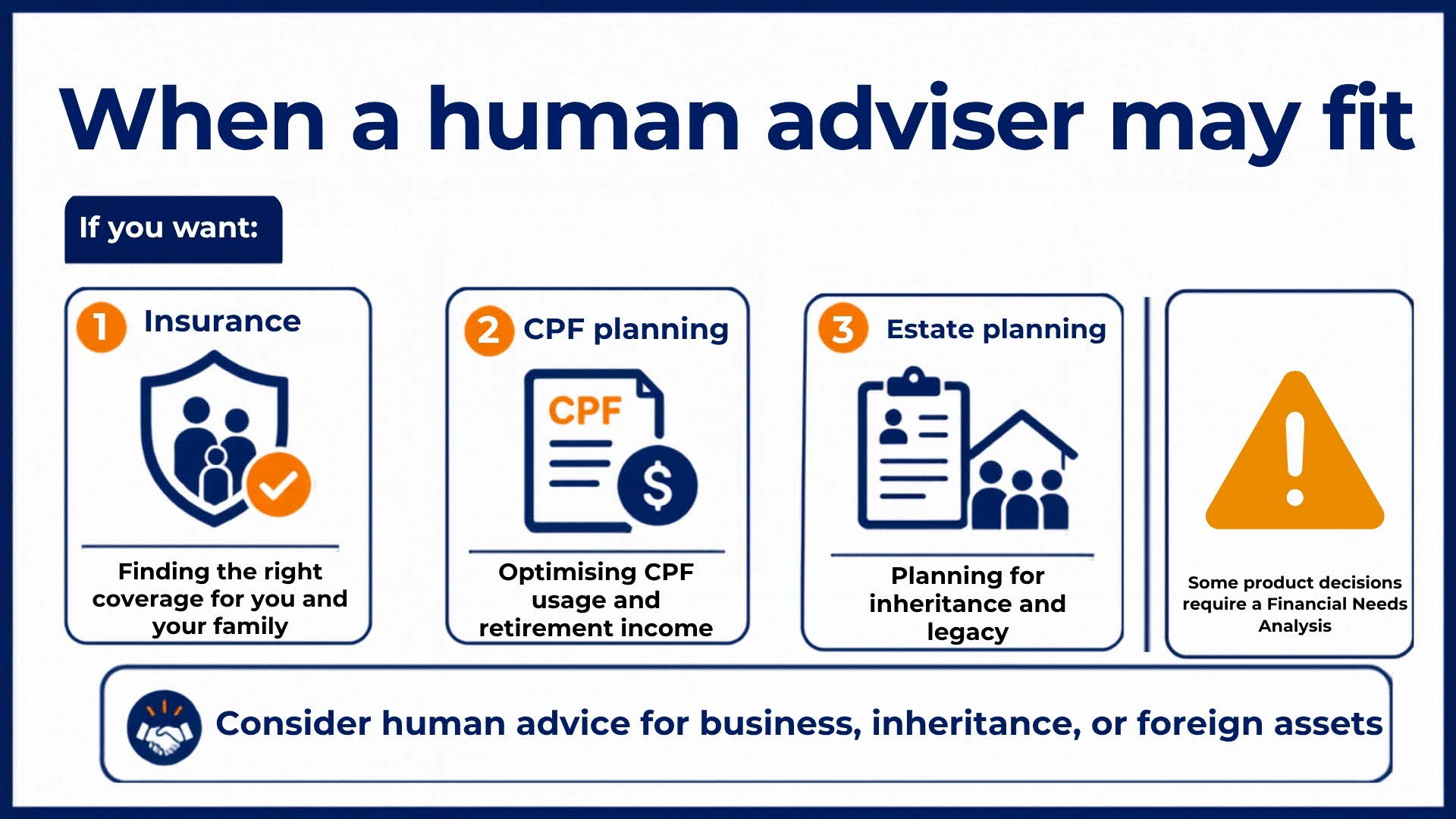
A traditional financial adviser is likely more appropriate if:
Your financial situation is multi-faceted — you own a business, have received an inheritance, hold significant foreign assets, or have estate planning needs.
You need integrated advice that combines investments, insurance, CPF, and tax planning in a coherent strategy.
You need someone to hold you accountable and provide behavioural coaching — to talk you out of panic-selling during a market crash, for example.
You are making a specific product decision (a life insurance policy, an Investment-Linked Insurance Policy, a structured deposit) where a human financial adviser is required to conduct a Financial Needs Analysis (FNA) and ensure suitability.
Questions to ask before choosing a robo-adviser
About the platform
Is the platform licensed by MAS? Check at eservices.mas.gov.sg/fid (opens in new tab). Do not invest through any platform that is not on this list.
What ETFs does the platform invest in? Study the fund factsheets for each underlying ETF — particularly the Total Expense Ratio (TER) and the index being tracked.
What is the total annual cost? Add the platform’s management fee to the weighted average TER of the underlying ETFs to get your true total cost.
How is the portfolio rebalanced? How often? What triggers a rebalance?
What happens during a market crash? Has the platform disclosed how its portfolios performed during major market downturns?
About your own situation
Does the platform offer CPFIS or SRS integration, if those channels are relevant to you?
Can you withdraw your money when you need it, and are there any fees or lock-in periods for withdrawal?
Does the platform offer the thematic portfolio option you want, if that matters to you?
Can you use both?
Yes. Many investors use a robo-adviser for their long-term investment portfolio — taking advantage of its low cost and automation — while working with a human adviser for more complex needs such as life insurance, CPF planning, or estate structuring. These are complementary, not competing, approaches.
Watch out for
Assuming a robo-adviser cannot lose you money. All robo-adviser portfolios invest in markets that go up and down. The platform manages risk through diversification, but cannot eliminate the risk.
Choosing a robo-adviser based solely on the past performance of its model portfolios. Past performance, particularly over short periods, is not a reliable indicator of future returns.
Ignoring total fees. A platform fee per annum plus underlying TEFs for ETFs may make a significant difference to your ending balance over 20 years.
Using a platform that is not MAS-licensed. Always verify at eservices.mas.gov.sg/fid (opens in new tab) before depositing any money.
Your next steps
Verify that any robo-adviser you are considering is MAS-licensed at eservices.mas.gov.sg/fid (opens in new tab).
For two or three shortlisted platforms, calculate the total annual cost: platform fee + weighted average ETF TER. Compare these to each other and to a self-directed ETF portfolio.
Read the portfolio disclosure for your preferred platform: What specific ETFs does it hold, and in what proportions? Check whether you are comfortable with the underlying exposures.
If your financial situation involves multi-faceted needs (business, estate, insurance), schedule a consultation with a human financial adviser before deciding whether a robo-adviser alone is sufficient.
For an overview on robo-advisers in Singapore
Frequently asked questions (FAQ)
Are robo-advisers regulated in Singapore?
Yes — Robo-advisers operating in Singapore must be regulated by MAS. You can verify a platform's regulatory status on the MAS Financial Institutions Directory. (opens in new tab)
How is my money protected if the robo-adviser company shuts down?
Your invested assets (the ETFs) are held in custody separately from the robo-adviser's own assets, meaning they cannot be used to pay the company's creditors if it fails. However, your investments are not covered by the Singapore Deposit Insurance Scheme (SDIC), which only covers bank deposits.
Can I use SRS funds with a robo-adviser?
Some robo-advisers accept SRS investments; others do not. Check each platform's specific terms. Using SRS with a robo-adviser can be a tax-efficient, low-effort approach to retirement investing.
What happens to my portfolio during a market crash?
Your portfolio value will fall in line with market movements — robo-advisers do not protect against market losses. However, they will typically rebalance automatically, buying more of the assets that have fallen in value (at lower prices) and trimming those that have held up.
How do robo-advisers compare to unit trusts in terms of fees?
Robo-advisers are generally significantly cheaper than actively-managed unit trusts. The key trade-off is unit trusts offer active management and potential outperformance; robo-advisers offer passive, systematic management at lower cost.
Related articles
Financial advice: Who you could be dealing with
There are different types of MAS-regulated financial advisers in Singapore—tied agents, independent advisers, and robo-advisers. Learn what suits you and how to verify credentials.
Guide to ETFs: Understanding Exchange-Traded Funds
ETFs offer diversification at low cost—but not all are the same. Understand how ETFs track indices, their liquidity advantages, and how they compare to unit trusts in Singapore.
Unit trusts: Guide to pricing and fees
Choosing the wrong unit trust is an expensive mistake. This comprehensive guide helps Singaporeans compare funds, understand costs, and build a diversified portfolio that makes sense.