
Guide to shares: What you need to know before you invest
What are shares and how do I make money from them? A beginner's guide to stock investing
Last updated on 25 November 2026
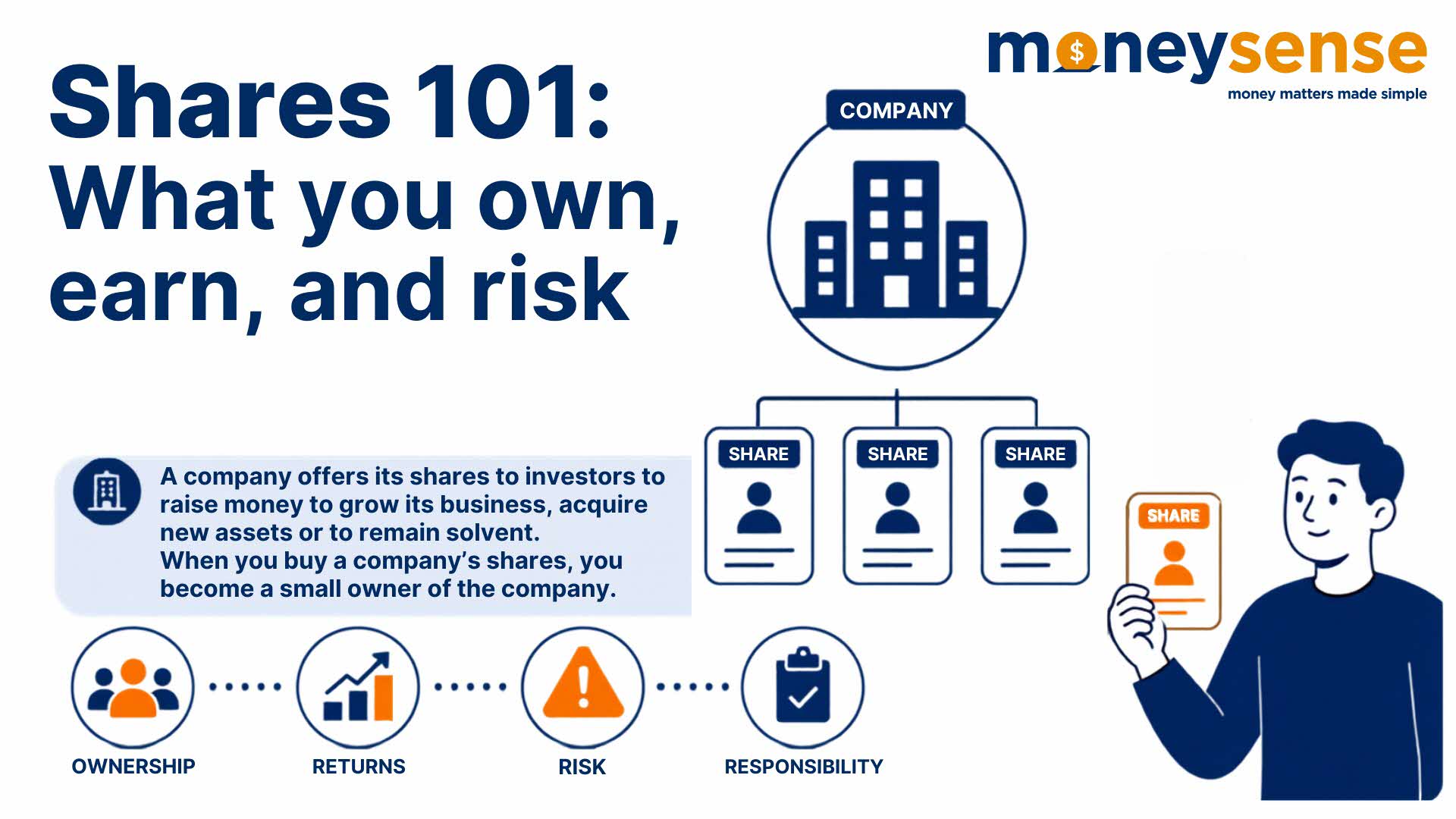
Key takeaways
When you buy shares, you become a part-owner of the company. Your returns could come from dividends and from selling at a higher price than you paid. Neither is guaranteed.
If a company fails and is wound up, shareholders are last in the repayment queue — you could lose your entire investment.
Share prices respond to economic conditions, industry trends, and company-specific news. Not all shares react the same way.
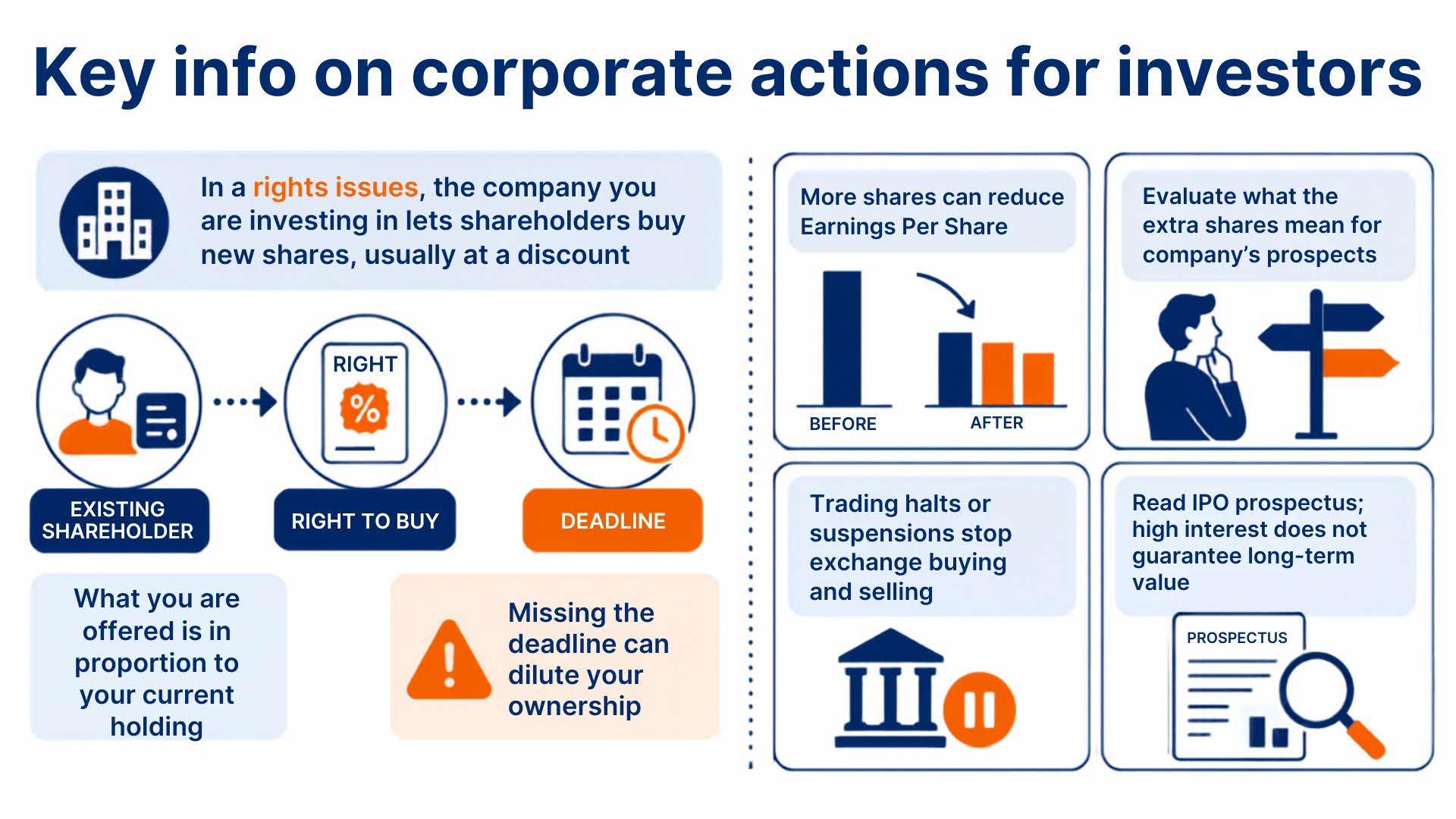
Corporate actions like rights issues require you to make decisions within deadlines. Inaction has consequences.
What are shares?
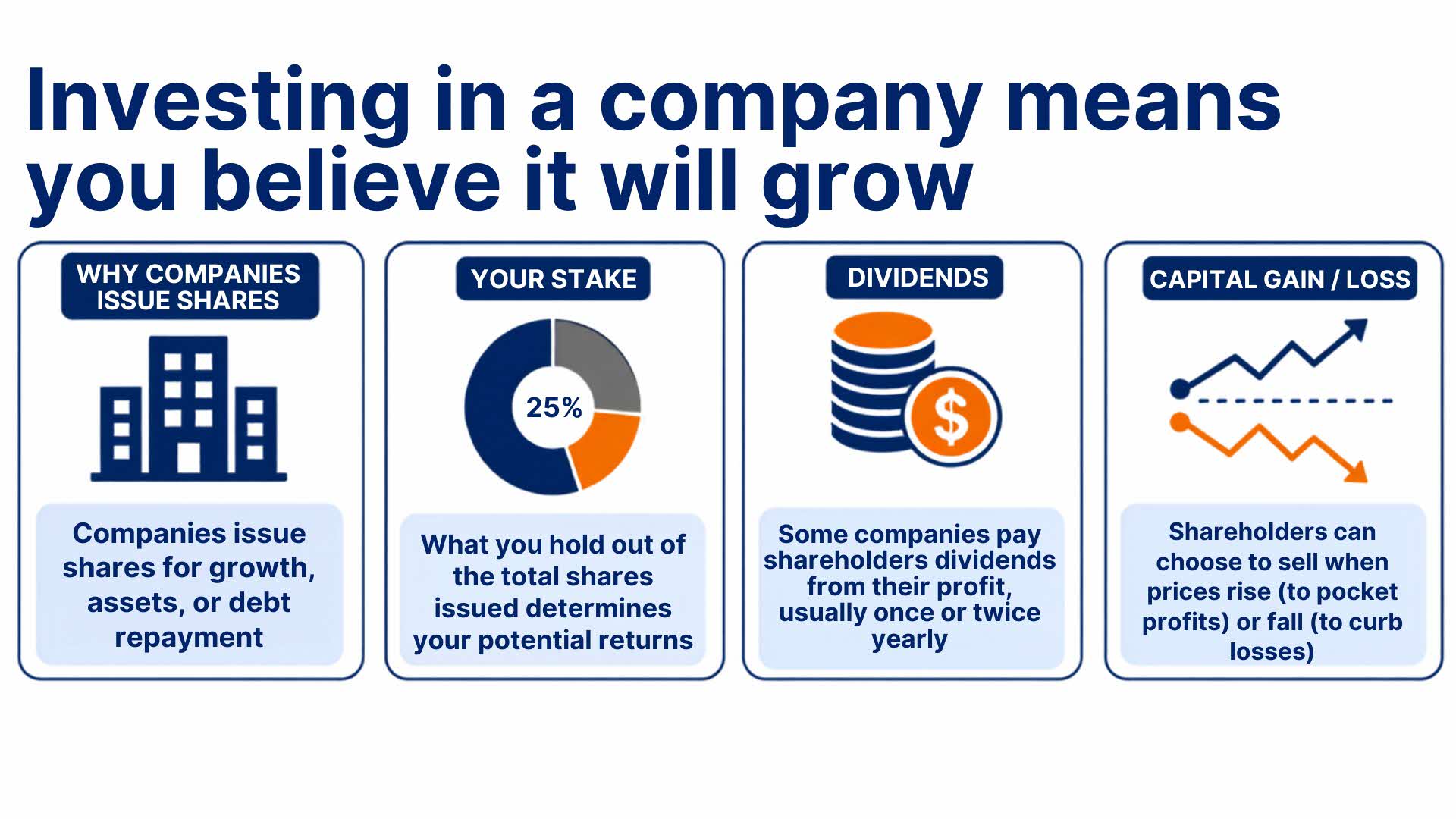
A company issues shares to raise money from investors — for example, to fund growth, acquire assets, or repay debt. When you buy shares, you become a part-owner, or shareholder, of that company. The proportion of the company you own corresponds to the number of shares you hold relative to the total shares in issue.
How do shareholders earn returns?
Dividends
Dividends are payments made to shareholders out of a company’s profits. They are typically paid once or twice a year, as a fixed amount per share. Dividends are not guaranteed — a company may reduce or stop them if profits fall, or it may choose to reinvest earnings back into the business instead of distributing them.
Capital gains
If you sell your shares at a higher price than you paid, the difference is a capital gain. Selling at a lower price produces a capital loss. Share prices change constantly, driven by economic conditions, industry developments, and company-specific news.
Types of shares
There are two main classes:
Ordinary (common) shares: The most widely-held type. Holders have voting rights at general meetings and receive dividends when declared. If the company winds up, ordinary shareholders are last in the queue to receive any remaining assets — behind all creditors.
Preference shares: Holders typically receive a fixed dividend before ordinary shareholders and rank higher in a wind-up, but usually have no voting rights.
Throughout this article, “shares” refers to ordinary shares unless stated otherwise.
What is the maximum you can lose?
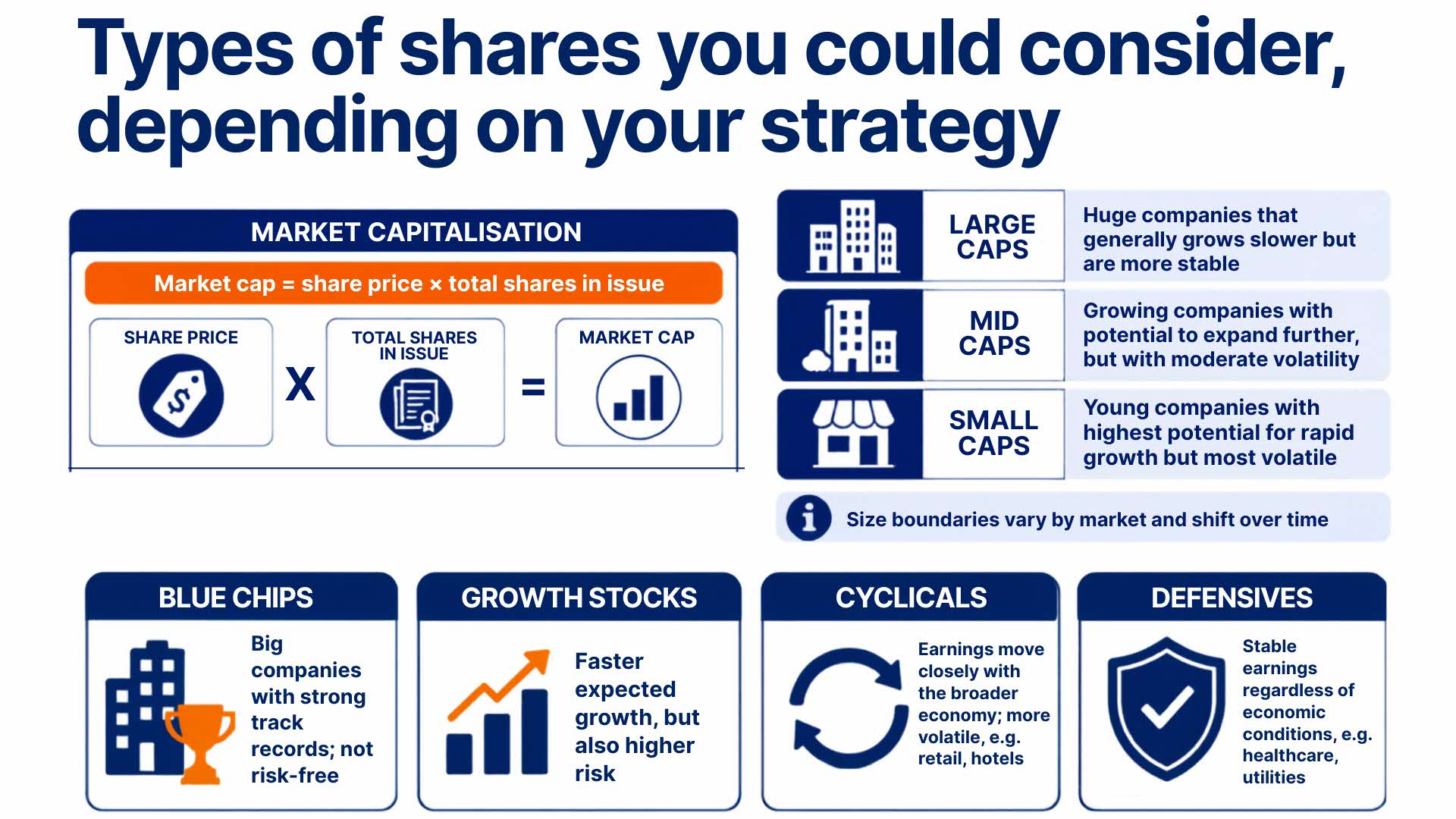
In the worst case, if a company fails and is wound up, shareholders rank behind all other creditors — banks, bondholders, suppliers, and employees. Once all debts are paid, if anything remains, it is distributed to shareholders. If nothing remains after creditors are paid, shareholders receive nothing. That means you could lose your entire investment.
Even short of insolvency, a company’s share price can fall sharply if the business performs poorly or faces serious financial difficulties. There is no floor on how far a price can drop.
Share categories: What the labels mean
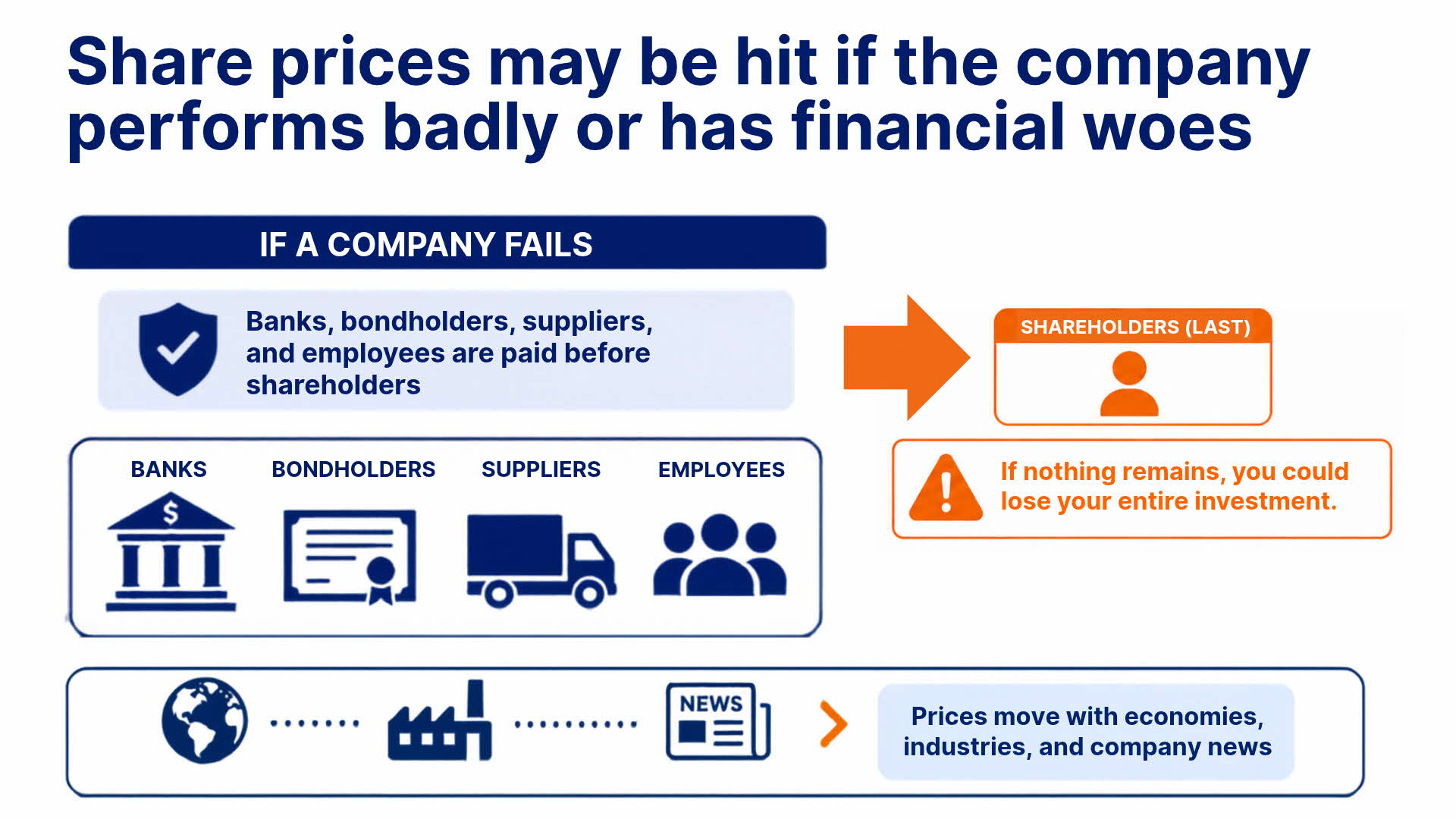
You will commonly encounter these informal categories, which are based on market convention and may change over time:
Share categories
Blue chips | Large, well-established companies with long track records of stable earnings and dividends. Examples on the Singapore Exchange (SGX) include major local banks. Generally considered lower-risk within equities, though not risk-free. |
Growth stocks | Companies expected to grow revenues and profits faster than average, often reinvesting profits rather than paying dividends. Higher potential return at higher risk. |
Cyclical stocks | Companies whose earnings move closely with the economic cycle — doing well in expansions and poorly in contractions. Examples: construction, travel, luxury goods. |
Defensive stocks | Companies in sectors with stable demand regardless of economic conditions. Examples: utilities, healthcare essentials, consumer staples. |
Market capitalisation: What it is and why it matters
A company’s market capitalisation is calculated as: share price × total number of shares in issue. It represents the total market value of all shares outstanding. Companies are often sorted into:
Large caps: Well-researched, more liquid, generally more stable. Institutional and retail investors follow them closely.
Mid caps: Growing companies with increasing research coverage and improving liquidity.
Small caps: Newer or smaller companies with less analyst coverage and less liquidity. Higher risk, but potentially higher returns.
Note: What counts as small, mid, or large cap varies by market. The boundaries are not fixed — they shift as market conditions and valuations change.
IPOs: Investing before a company lists
Companies seeking to list on the SGX typically make an Initial Public Offering (IPO) of their shares. You can subscribe to an IPO through internet banking, bank ATMs, or hardcopy subscription forms. The company must register a prospectus with the Monetary Authority of Singapore (MAS) before the IPO.
Read the IPO prospectus carefully before subscribing. It discloses the company’s business model, financials, risks, and how the proceeds will be used. High investor interest in an IPO does not guarantee a good long-term investment.
Is share investing right for you?
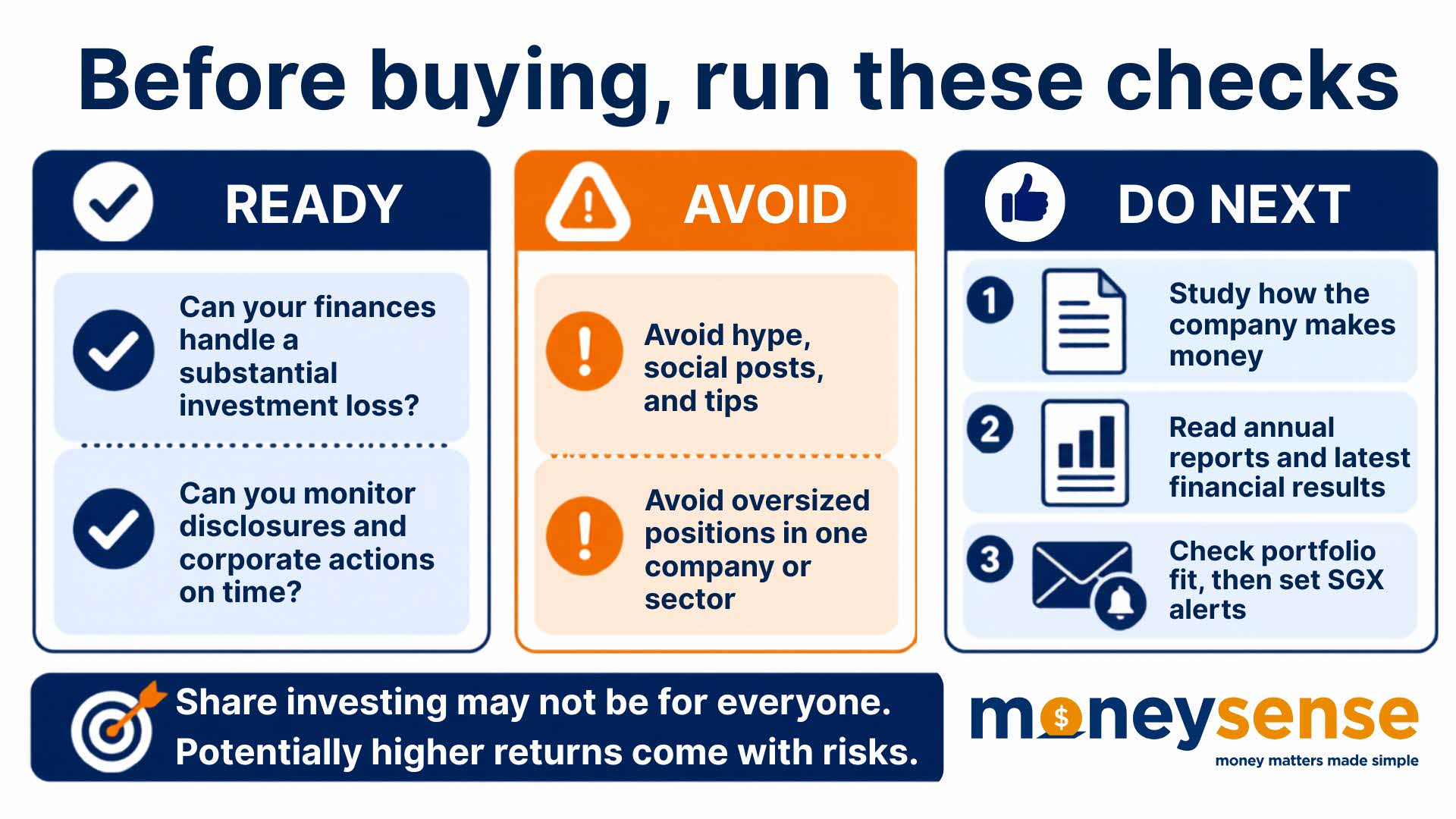
Consider whether you can honestly say “yes” to all of the following:
I understand the factors that affect share prices and am prepared for significant volatility.
I have sufficient financial resilience to absorb a substantial loss, including losing my entire investment.
I have the time and resources to monitor the market, read company disclosures, and respond to corporate actions on time.
I am prepared to hold my investment for a meaningful period — typically years — to weather short-term price swings.
I can build a sufficiently diversified portfolio and avoid over-concentration in any single company or sector.
Watch out for
Investing in a company because of hype, social media posts, or tips from friends, without reading the company’s own financial disclosures.
Ignoring rights issue notices or letting deadlines pass without acting. Missing a rights issue deadline means your shareholding will be diluted without any benefit.
Buying into an IPO solely because it appears heavily oversubscribed. Oversubscription reflects short-term demand, not long-term value.
Holding a heavily concentrated position in one company. Even high-quality companies can be severely affected by sector-wide shocks or management failures.
Your next steps
Before buying any share, write down what the company does, how it makes money, and what would have to go wrong for your investment thesis to fail.
Read the company’s latest annual report and most recent set of financial results — available on its investor relations page or at sgx.com (opens in new tab).
Review your planned shareholding in the context of your whole portfolio: does it add genuine diversification, or increase concentration in sectors you already own?
Set up SGX email alerts (sgx.com (opens in new tab)) for companies you hold so you receive corporate action announcements as soon as they are published.
For an overview of what to know before buying shares
Frequently asked questions (FAQ)
How many stocks do I need to be properly diversified?
Studies suggest that 20–30 randomly selected stocks from the same market eliminate most stock-specific risk. However, you still retain all the risk of that single market. Meaningful diversification requires spreading across markets and asset classes, not just owning more stocks in the same market.
Is investing in different Singapore stocks enough diversification?
No — this is a common misconception. Owning 10 Singapore stocks reduces individual stock risk but leaves you fully exposed to Singapore-specific economic, political, and market risks. The SGX market is dominated by banks, real estate, and industrial stocks — a narrow slice of the global economy.
What is “over-diversification” and is it a real concern?
Over-diversification occurs when adding more investments stops reducing risk and only adds complexity and cost. Owning 50 overlapping ETFs that all track similar indices achieves nothing beyond the first few. A well-constructed portfolio of 2–4 broadly diversified funds is typically sufficient for most retail investors.
Does having savings, property, and stocks mean I'm already diversified?
Partially — you have assets across different categories. But note that property and Singapore stocks may both be highly correlated to the Singapore economy. Review whether your financial assets (stocks, bonds, funds) are themselves well-diversified, rather than assuming overall asset variety equals true diversification.
How do I diversify geographically if I only invest on SGX?
The SGX lists several internationally-focused ETFs, including funds that track global indices. Robo-advisors also typically invest in a globally diversified portfolio of ETFs. Alternatively, overseas brokerage accounts give direct access to US-listed ETFs, which may have lower expense ratios.
Related articles
Guide to shares: How to invest
From CDP account to first trade—here’s the complete practical guide to buying and selling shares in Singapore, including order types, transaction costs, and what to watch out for.
Managing investment risk
Learn about managing investment risks, diversification, correlation, asset allocation and dollar-cost averaging to make informed investment decisions.
An introduction to types of investments
Discover the basics of investment in Singapore, including types of assets and starting essentials. Make informed decisions for your financial future now.