
Using AI for your finances: What you need to know
AI can be a useful research tool for financial planning, but it may not always get things right. Understand what AI can and can’t do, and how to use it safely when making financial decisions.
Last updated on 22 October 2026
Key takeaways
AI can be a starting point for researching about personal finance topics like investing and budgeting but always verify information, such as with official sources and licensed financial advisers
Not all financial tasks are equally suited to AI, and AI may not be able to fully assess your personal financial situation
Protect your personal financial data when using AI tools by checking privacy settings and not sharing sensitive information
How people are using AI for money matters
You may already be using AI for your money matters without realising it. Your banking app may use AI to detect fraud or categorise transactions, while investment platforms may use algorithms to suggest portfolio allocations.
More recently, some people have started using publicly available AI chatbots to:
Understand financial concepts and products in simpler terms
Create monthly budgets and analyse spending patterns
Compare different investment options
These AI tools can quickly process information, explain complex financial terms, and even suggest investment strategies. It's tempting to rely on them -- they're free, available 24/7, and seem to have answers for everything.
However, using AI to manage your finances comes with limitations and risks. While AI has broad general knowledge, it doesn’t fully understand your personal circumstances. It also carries no regulatory responsibility.
Never use AI as your sole source of financial information. Do not make final financial decisions based on its recommendations without verifying them, such as through official sources or a licensed financial adviser.
Where AI can help
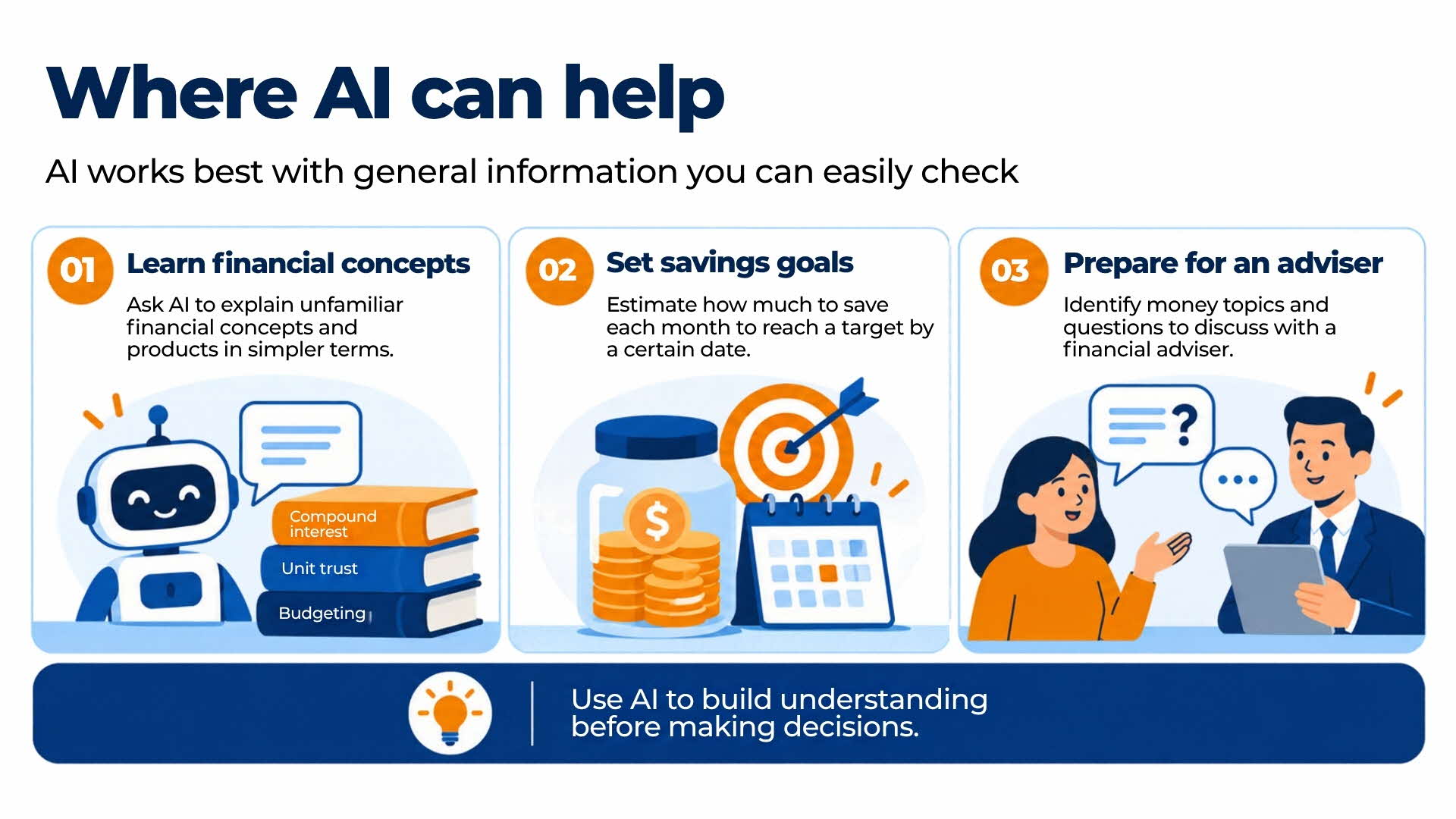
AI works best for tasks where information is general, and you can easily check whether it applies to you. This includes:
Learning financial concepts: If you want to understand how compound interest works or what a unit trust is, AI can explain these concepts clearly and quickly. It’s a simple way to build your financial knowledge before you make any decisions.
Setting savings goals: AI can estimate how much you need to save each month to reach a target by a certain date, making your goals feel more concrete and manageable.
Preparing questions for a financial adviser: You can use AI to identify financial areas you may want to discuss, and questions you can ask to address your concerns and goals.
Where AI can be a starting point, but you should verify the information
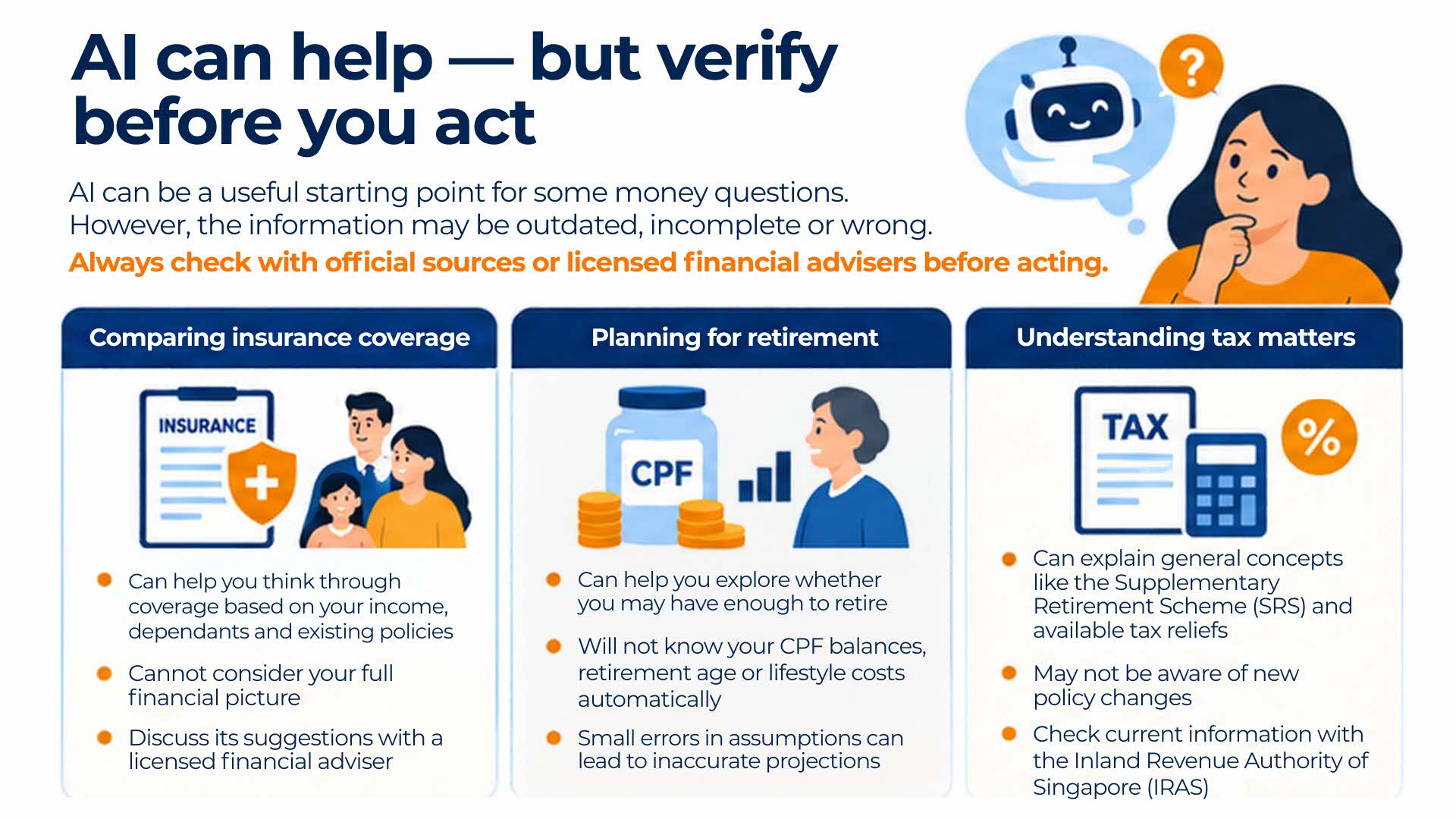
AI can help with below tasks, but there is a risk of the AI output being outdated, incomplete, or wrong. Always cross-check with official sources or licensed financial advisers before acting on what you find.
Comparing insurance coverage: AI can help you think through the types of coverage that may suit your needs by walking you through questions about your income, dependants, and existing policies. However, AI cannot consider your full financial picture and may be outdated on policy changes. Treat its suggestions as a starting point, before a conversation with a licensed financial adviser.
Planning for retirement: You can ask an AI chatbot: “Will I have enough to retire?”, and it can help you think through the question broadly, but the answer depends on many personal factors. AI will not be aware of your CPF balances, expected retirement age, and lifestyle costs. Small errors in the assumptions may lead to big inaccuracies in its retirement income projections.
Understanding tax matters: AI can explain general concepts such as how the Supplementary Retirement Scheme (SRS) works or identify what tax reliefs are available. However, AI may not be aware of new policy changes. For accurate guidance, refer to official sources such as the website of the Inland Revenue Authority of Singapore.
When you should consult a financial adviser instead of AI
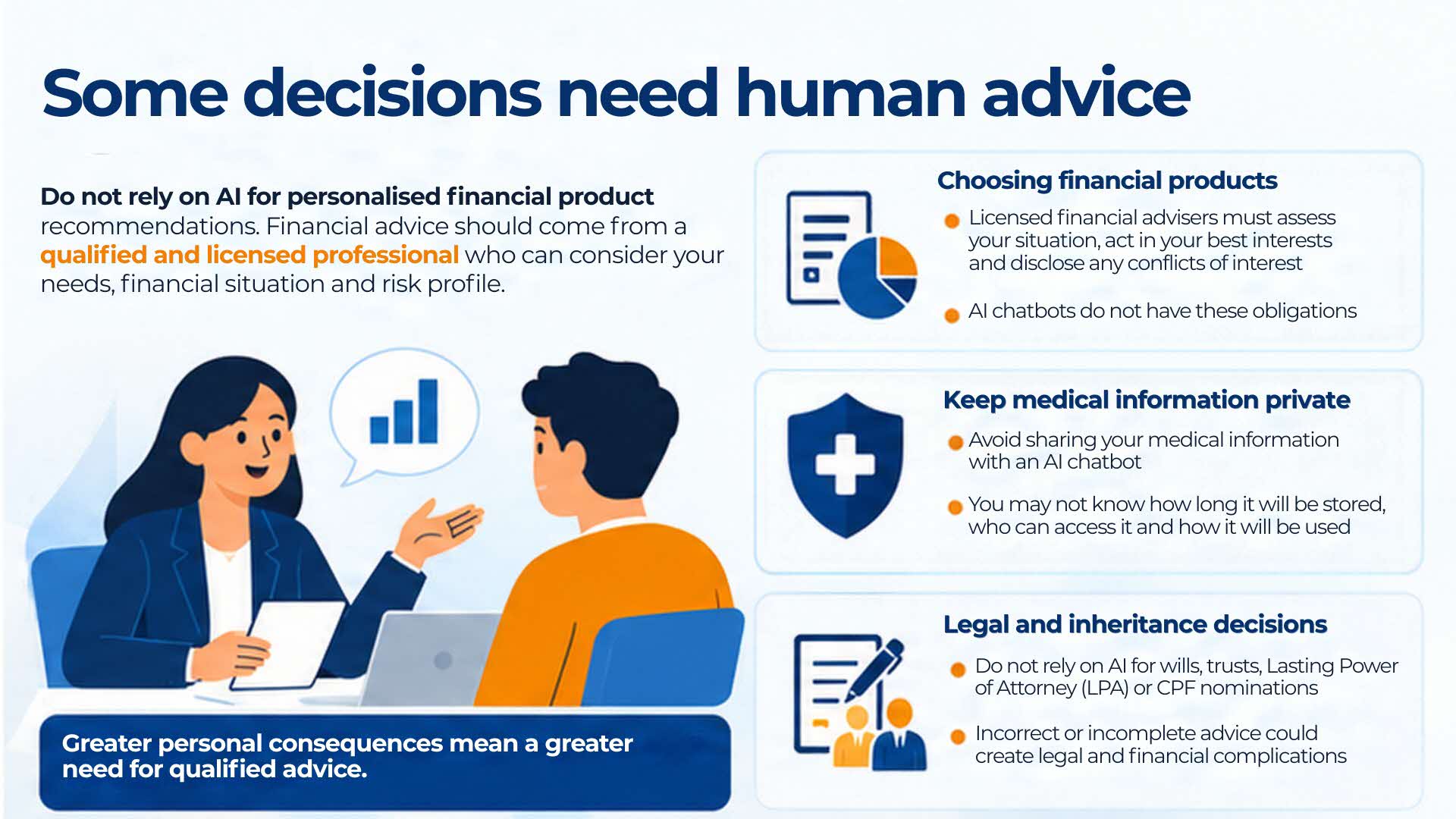
Do not rely on AI to recommend specific insurance, investment, or financial products for you. Financial advice should come from a licensed professional who can consider your needs, financial situation, and risk profile. Consult a financial adviser for the following:
Choosing financial products: Only licensed financial advisers are permitted to make personalised product recommendations in Singapore, and they are required to assess your personal situation, act in your best interests and disclose any conflicts of interest. AI chatbots have none of these obligations, so their recommendations may not be suitable for your financial situation, goals or risk appetite.
Sharing private medical information: Avoid sharing your medical information with an AI chatbot when discussing insurance. Once you share sensitive personal data with the AI platform, you may not know how long it will be stored, who can access it, and how the data is used. If you need advice about insurance, discuss your medical information directly with a financial adviser.
Making legal and inheritance decisions: Do not rely on AI to decide how you should handle matters such as wills, trusts, Lasting Power of Attorney (LPA), CPF nominations or estate planning. These decisions have legal consequences and depend on your personal and family circumstances. Following incorrect or incomplete advice could create legal and financial complications for your loved ones. Speak to a legal professional or financial adviser instead.
What AI may get wrong
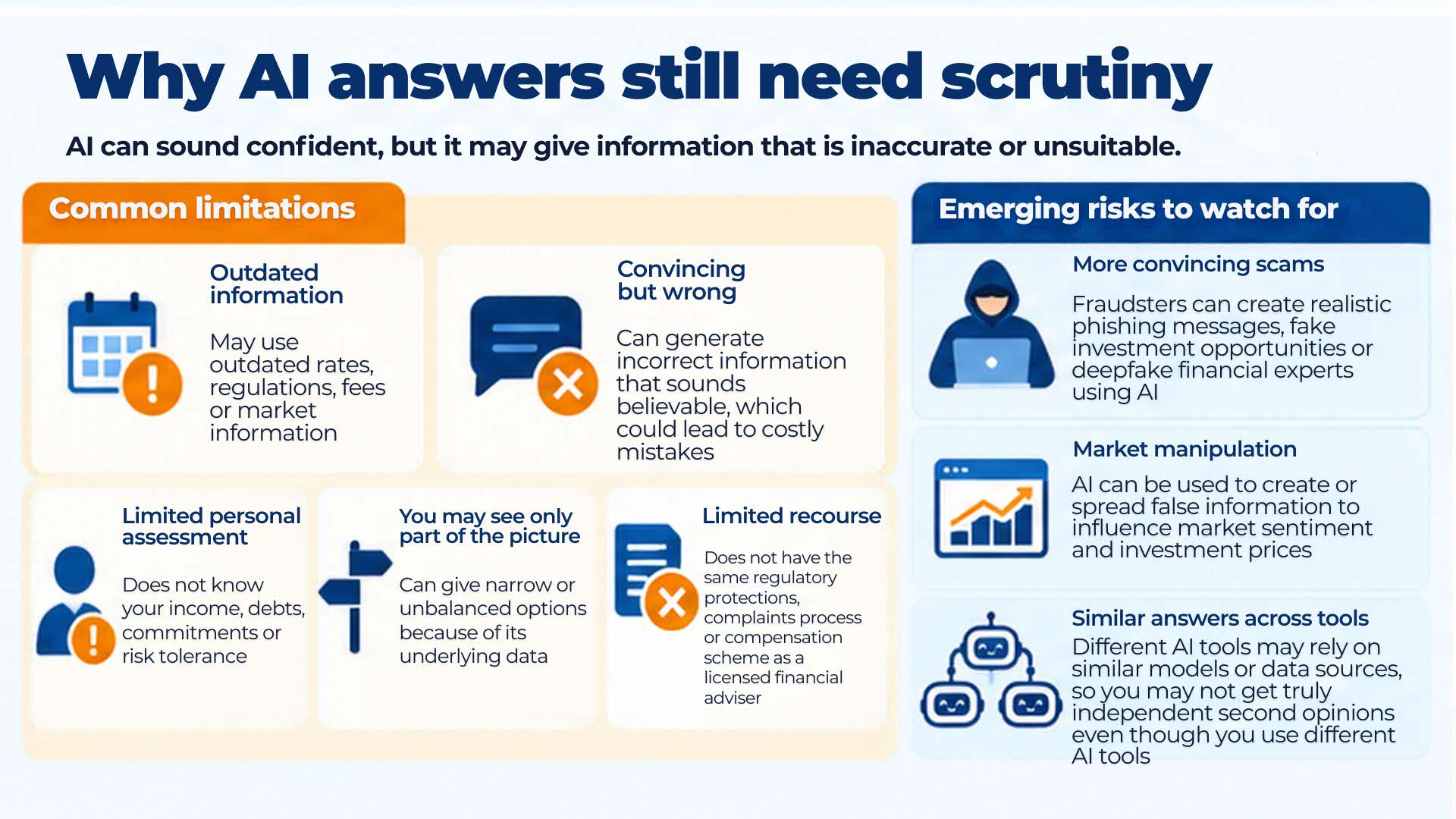
Outdated information: Publicly available AI chatbots may not be updated with current market conditions, interest rates, or regulatory changes. This means you might get advice based on old CPF contribution rates, outdated MAS regulations, or incorrect product fees.
Hallucination risk: AI can sometimes generate information that sounds convincing but is incorrect. For example, it might misstate the risks of investment-linked policies or provide inaccurate details about loan eligibility. If you rely on this information without checking, you could misunderstand how a financial product works and its risks, and end up making costly mistakes.
Limited personal assessment: Unlike a qualified financial adviser who conducts a Financial Needs Analysis, AI cannot properly assess your complete financial picture. It does not know your actual income, existing debts, family obligations, or risk tolerance unless you provide that information – and even then, it may not interpret it accurately. For example, a publicly available AI chatbot could suggest an investment that exposes you to more risk than you’re comfortable with or recommend a savings plan that doesn’t suit your needs.
Model bias and data quality issues: AI systems can produce biased outputs due to the data they were trained on or how they were designed. This could mean you’re presented with a narrow or unbalanced view of your options, which may cause you to overlook alternatives that could be more suitable or cost-effective for your circumstances.
Zero consumer protection: This is crucial - AI tools are not regulated and have no obligation to act in your best interests. If you lose money following AI-generated advice, you have no recourse. There is no complaints process, no compensation scheme, and no professional standards to fall back on.
Emerging risks you should know about
Cybersecurity and fraud risks: Bad actors are increasingly using AI to create more sophisticated scams. They can generate fake investment opportunities, create deepfake videos of supposed financial experts, or develop convincing phishing schemes. AI-powered fraud is becoming harder to detect and more personalised to individual victims.
Market manipulation concerns: AI systems can be used to spread misinformation or manipulate market sentiment through fake news, social media posts, or fraudulent research reports. This could affect the prices of investments you're considering.
Concentration risks: Many AI systems rely on the same underlying models and data sources. Investors may think they are getting independent advice when consulting different AI tools, but they are actually receiving variations of the same potentially problematic guidance.
How to use AI safely for finance
Use AI as a starting point, not the final word
Think of AI as a research assistant, not a financial adviser. Use it to:
Get basic explanations of financial concepts
Summarise key points from official documents
Generate questions to ask a real financial adviser
Create initial budget frameworks
Always verify information
Cross-check any AI-generated information with official sources:
MAS website for regulatory requirements
CPF Board for retirement planning
MoneySense for unbiased financial education
Product providers for current fees and terms
Protect your privacy
When using AI tools for financial planning:
Don't input sensitive personal information like banking account details, exact income figures, or medical history
Check the AI platform's privacy policy and understand how your data might be used
Consider using hypothetical examples rather than your real financial situation
Be aware that your conversations with AI tools might be stored and used to train future models
Understand the limitations
Remember that AI systems:
May not adapt to rapidly changing market conditions
May give different answers to the same question, even when the information provided is unchanged
May not perform as intended during market stress or unexpected events
Know when to seek human advice
You should consult a licensed financial adviser when:
Making major financial or investment decisions
Buying insurance or investment products that should be tailored to your specific circumstances and risk profile
Dealing with complex financial situations like inheritance or business ownership
Action steps
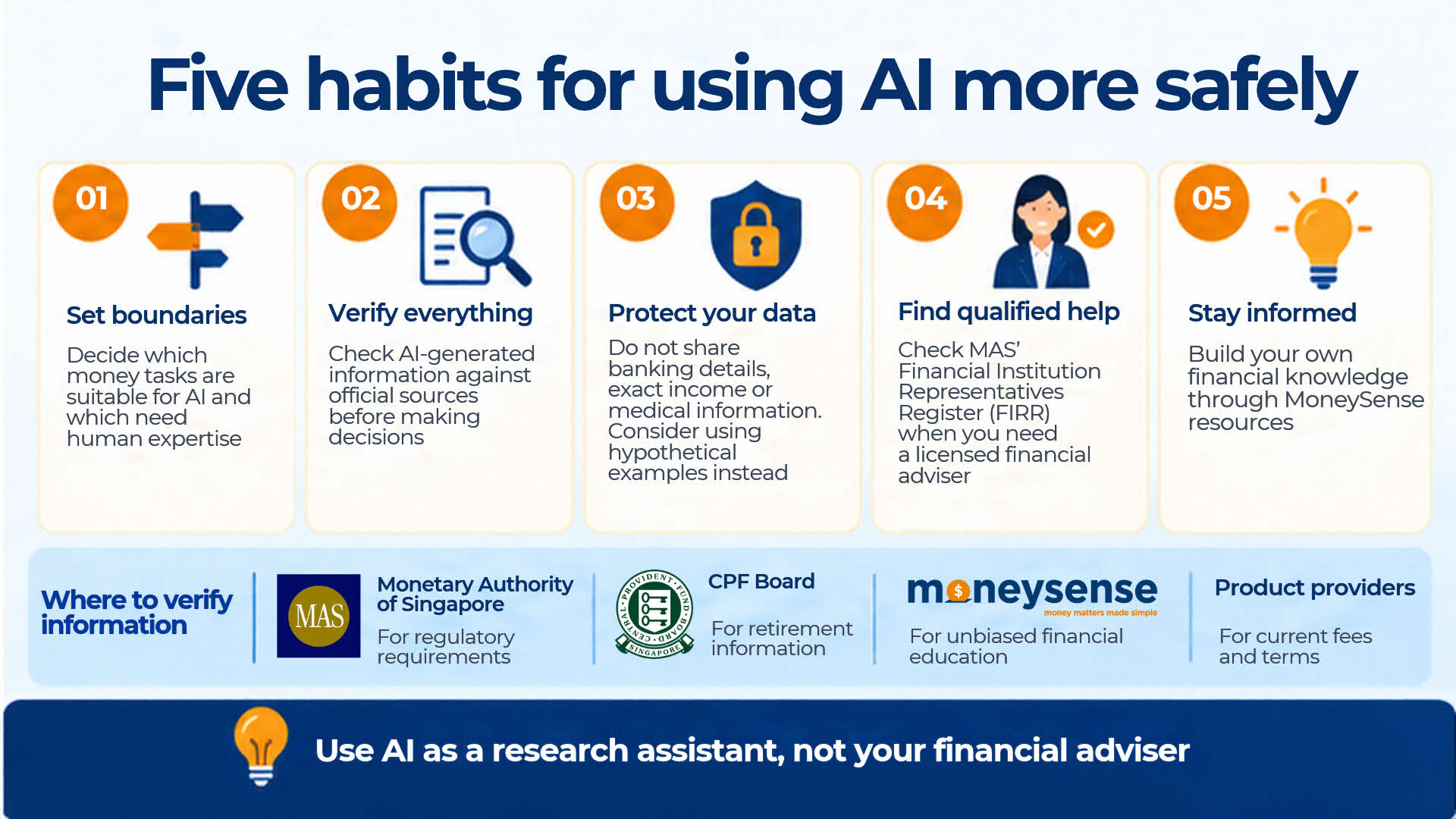
Set boundaries: Decide what financial tasks you're comfortable using AI for and which require human expertise
Verify everything: Always check AI-generated information against official sources before making decisions
Protect your data: Review privacy settings and avoid sharing sensitive financial information with AI tools
Find qualified help: Identify licensed financial advisers through MAS’ Financial Institution Representatives Register (FIRR) (opens in new tab) when you need personalised advice
Stay informed: Keep up with MoneySense resources to build your own financial knowledge alongside any AI assistance
For an overview on using AI for your finances
Related articles
Financial advisory process
Before you discuss insurance or investments with your financial adviser, learn about the process for analysing your needs and recommending products to you.
What to ask when buying an investment product
Never let enthusiasm replace due diligence. Use this essential checklist—covering fees, risks, liquidity, and adviser credentials—before putting your money into any investment product.
How to spot an investment scam
Scammers are more convincing than ever—and Singaporeans are losing millions. Recognise the red flags of investment scams, fake platforms, and chat group schemes before it’s too late.