
Setting financial goals at every life stage
How do I set financial goals in Singapore? A life-stage guide to investing with purpose.
Last updated on 19 October 2026
Key takeaways
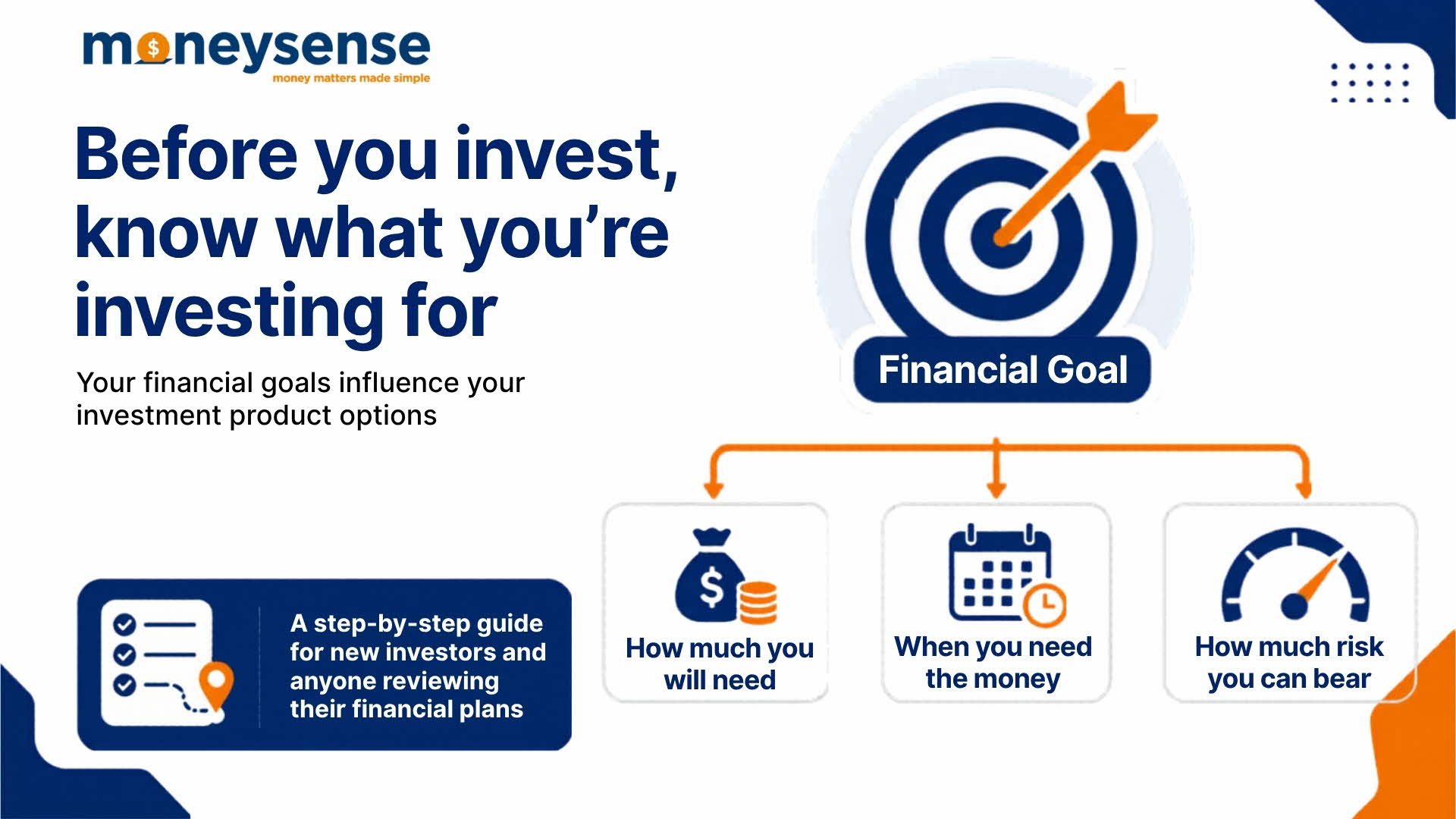
Every investment decision should start with a clear financial goal — knowing why you are investing shapes what you invest in and for how long.
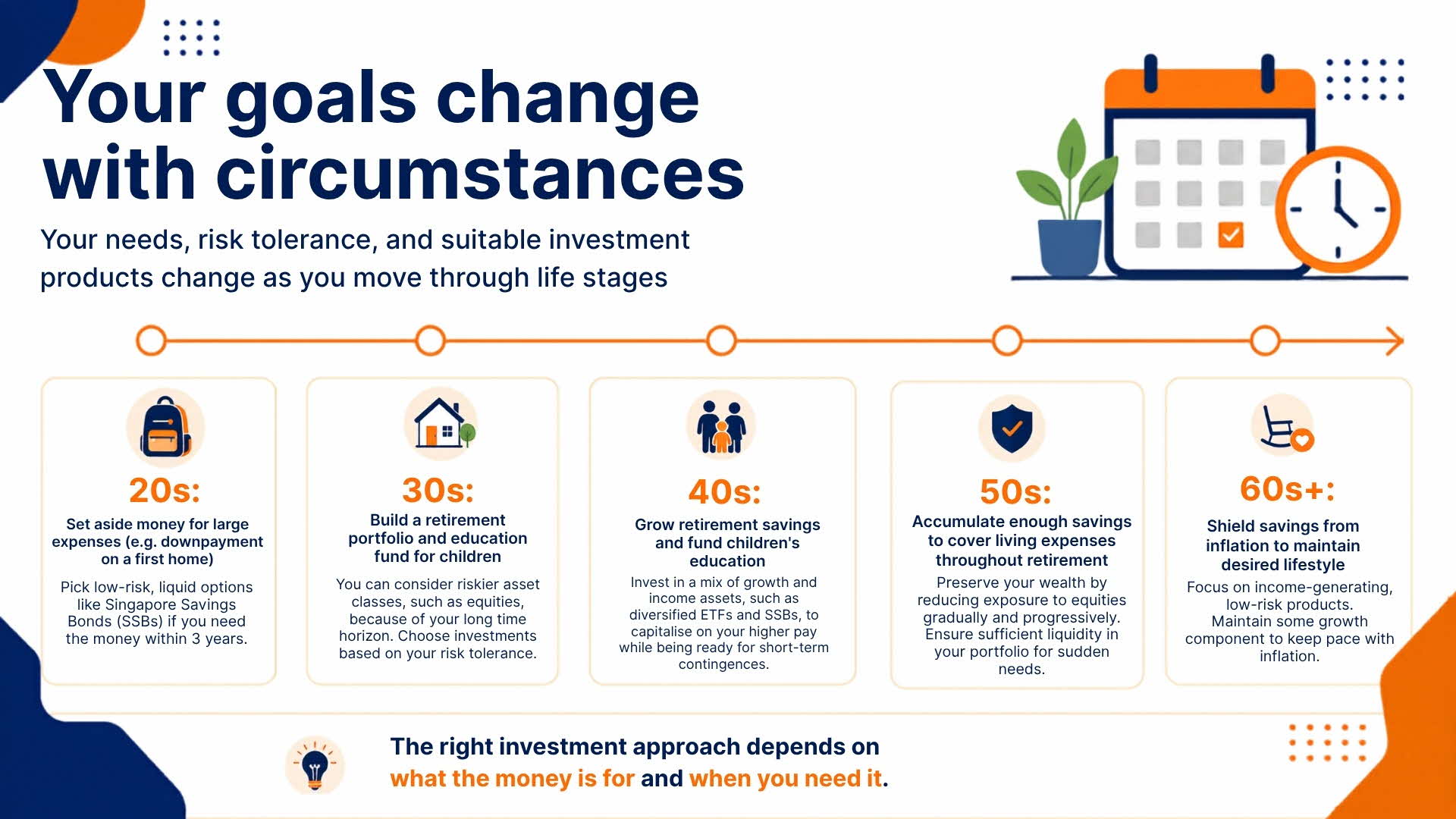
Your goals, risk tolerance, and appropriate investment products change as you move through life stages.
A simple goal-setting framework: Name the goal, set the target amount, and fix the date by which you need it.
Why goals come before products
A common investing mistake is starting with the product (“I want to buy a REIT”) rather than the goal (“I need $100,000 in 15 years for retirement”). The goal determines the timeline, and the timeline determines how much risk you can afford to take, which in turn narrows down the suitable product types.
Without a goal, it is difficult to measure whether your investments are on track, determine when to rebalance, and assess how to handle a market downturn.
A simple goal-setting framework
For each financial goal, define three things:
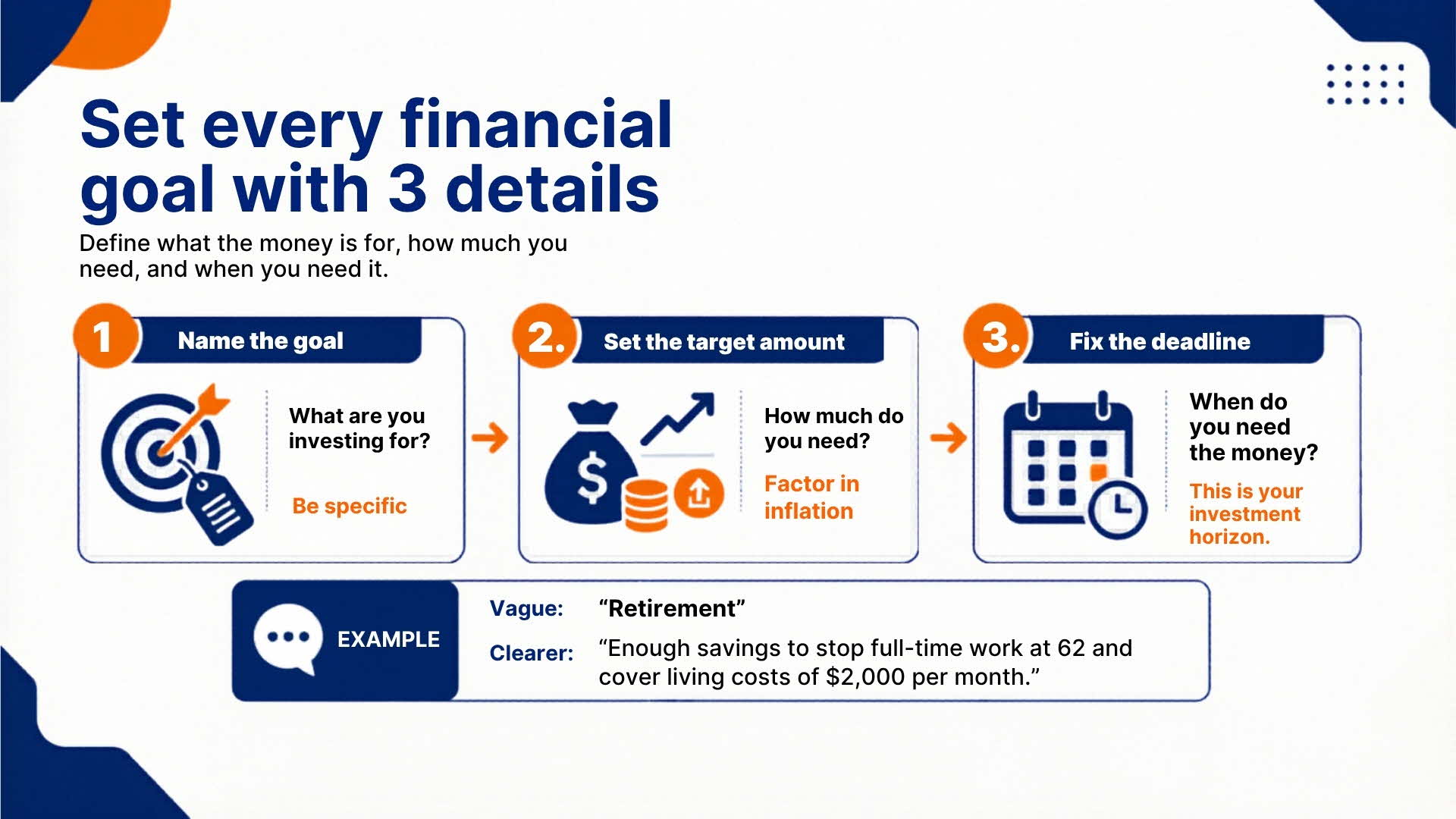
The goal: What are you saving or investing for? Be specific. “Retirement” is vague; “enough savings to stop full-time work at 62 and cover living costs of $2,000 per month” is a goal that is quantifiable and therefore measurable.
The target amount: How much do you need? Factor in inflation — $500,000 today will buy less in 20 years.
The deadline: When do you need this money? This gives you your investment horizon, which determines how much short-term volatility you can absorb.
Common financial goals for Singaporeans, by life stage
If you are new to investing, learn more about it and the pre-requisites (opens in new tab).
Common financial goals for Singaporeans, by life stage
Life stage | Typical financial goals or milestones | General investment implications |
20s (Starting out) |
|
|
30s (Setting up) |
|
|
40s |
|
|
50s (Consolidating finances) |
|
|
60s+ (Retirement) |
|
|
Singapore-specific anchors
When setting your financial goals, use Singapore’s specific financial structures as reference points:
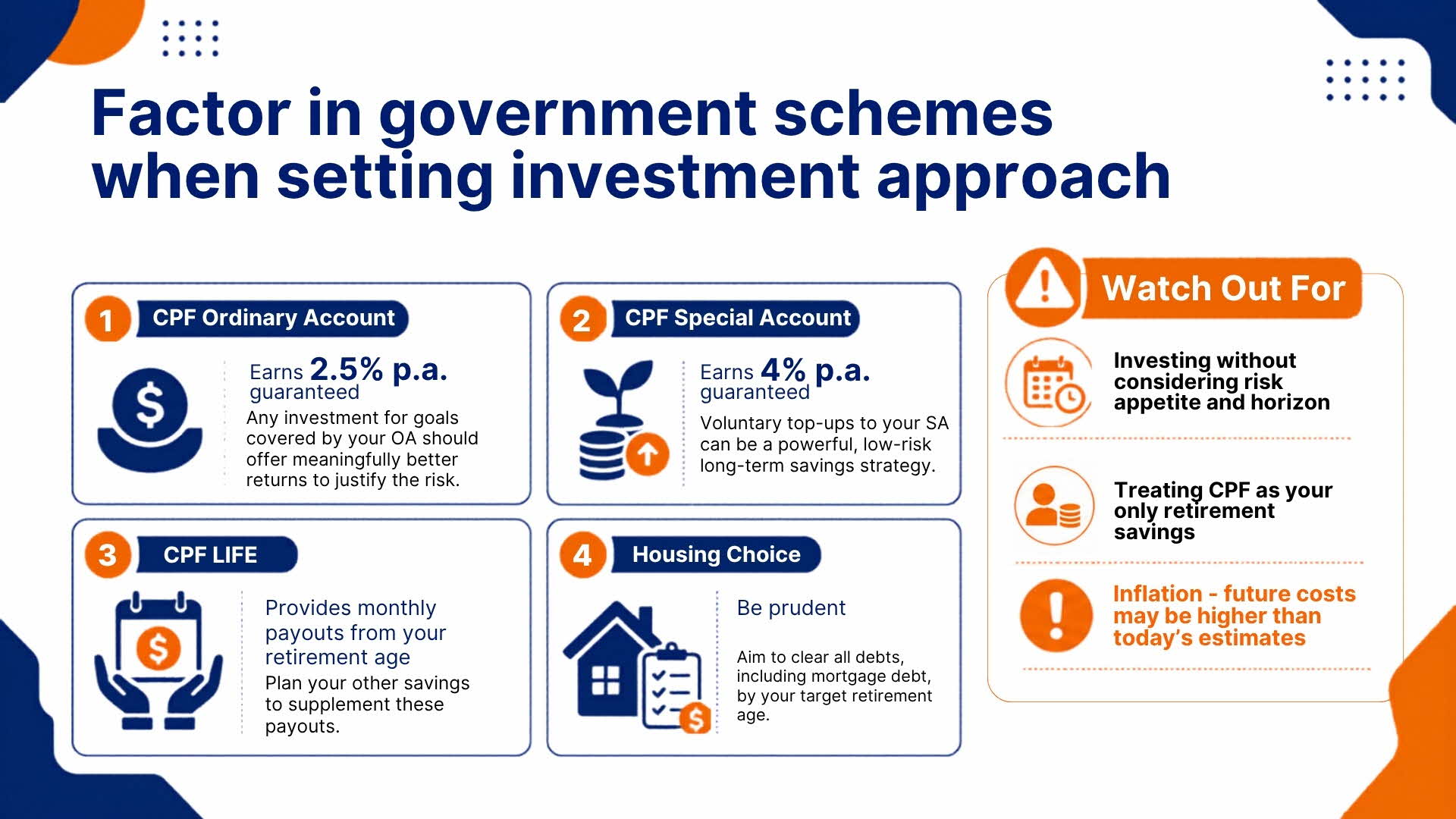
CPF Ordinary Account (OA) earns 2.5% p.a. (guaranteed): Any investment for goals covered by your OA should offer meaningfully better returns to justify the risk.
CPF Special Account (SA) earns 4% p.a. (guaranteed): Voluntary top-ups to your SA can be a powerful, low-risk long-term savings strategy.
CPF LIFE: Singapore’s national longevity insurance scheme provides monthly payouts from your retirement age. Plan your other savings to supplement these payouts.
Housing Choice: When considering the purchase of a property, be prudent and retain $20,000 in your CPF OA as a safety net. Preserve CPF savings for retirement and ensure you can clear all debts, including mortgage debt, by your target retirement age.
Watch out for
Setting goals without deadlines. A goal without a date is just a wish.
Treating your CPF as your only retirement savings. CPF savings serves as the foundation of our retirement income, with CPF LIFE providing lifelong monthly payouts. For higher monthly payouts to meet your desired retirement lifestyle, top up your CPF account.
Ignoring inflation. A goal of “save $200,000 for retirement in 30 years” without accounting for inflation understates what you will need to support your desired lifestyle. Consider the CPF LIFE Escalating Plan to help maintain your lifestyle as prices increase.
Your next steps
Write down your top three financial goals today, with a target amount and a deadline for each.
Use CPF’s Retirement Payout Planner (opens in new tab) to estimate how much you need to save per month to reach your retirement income goal. Consider the Planner’s suggestions to close the gap between projected savings and retirement income goals.
Check out Your Financial Basics (opens in new tab) and review whether you have adopted the recommended rules of thumb for emergency funds, protection and investments.
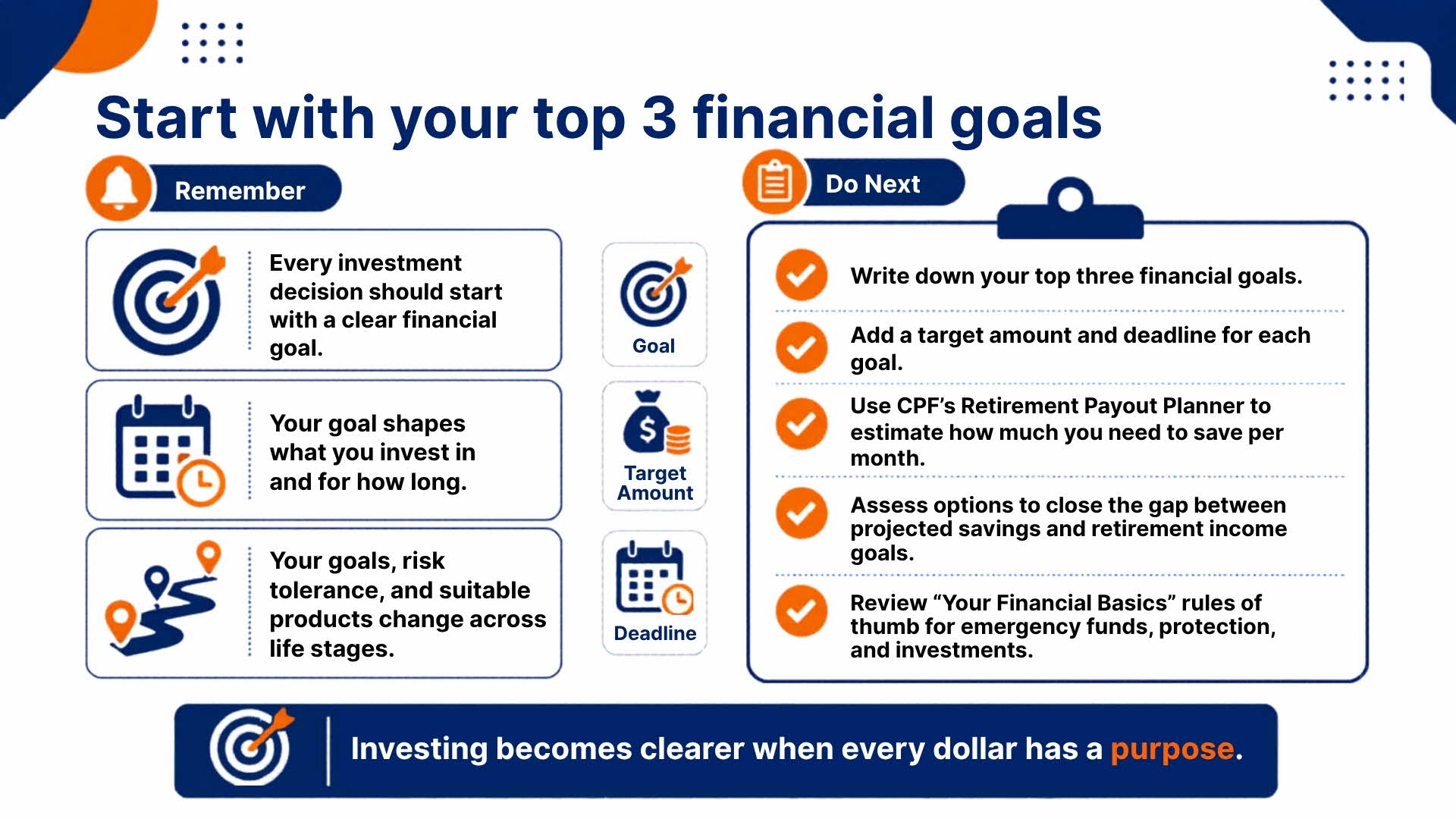
For an overview of setting financial goals at every life stage
Frequently asked questions (FAQ)
When should I start investing — is it too late if I'm 45?
It is never too late. At 45, you potentially still have 20 years before retirement and 20+ years of post-retirement life ahead. The key is adjusting your risk profile and goals appropriately for a shorter accumulation horizon, and starting immediately rather than delaying further.
How do I adjust my portfolio as I age?
Gradually shift from growth-oriented assets (e.g. equities) to lower risk assets (e.g. government bonds) as you approach retirement. The transition should be gradual — say, reducing equity allocation by 1–2% per year from your early 50s — rather than a sudden dramatic shift.
Should I invest differently after having children?
Having children should trigger a review of your overall financial and retirement plan. Ensure adequate term life and hospitalisation insurance coverage, consider starting an education savings plan, and reassess your emergency fund. Your investment risk tolerance may be somewhat lower given your increased financial obligations.
Is it safe to invest more aggressively in my 30s?
A higher equity allocation is generally appropriate for investors with long time horizons and higher risk tolerance. However, if a market crash would cause you to panic-sell, a slightly more conservative allocation that you can stick to is better than an aggressive one you can't maintain.
Related articles
What is investing?
Saving is not enough to beat inflation. Discover why Singaporeans invest, how risk and return are linked, and what separates smart investing from costly speculation.
Managing investment risk
Higher returns always come with higher risk—but which risks are you actually taking? Understand market, credit, liquidity, and currency risk before building your Singapore portfolio.
Putting together an investment portfolio
A good portfolio doesn’t manage itself. Learn how to diversify, allocate assets, rebalance strategically, and keep your Singapore investments aligned with your real financial goals.