
How do I choose between ETFs that track the same index?
S&P500 ETF comparison: Which ETF should I buy when there are so many options?
Last updated on 21 September 2026
Key takeaways
Many ETFs track the same index (e.g. the S&P 500 or the MSCI World), but they are not identical products. They differ in cost, strategy, currency, domicile, and dividend treatment.
The Total Expense Ratio (TER) is the starting point for comparison, but it is not the only cost that matters. Bid-ask spreads, brokerage commissions, and withholding taxes also affect your net return.
For many retail investors in Singapore, a small number of low-cost, liquid ETFs cover most of what is needed. You do not need to hold every variation.
Why are there so many ETFs tracking the same index?
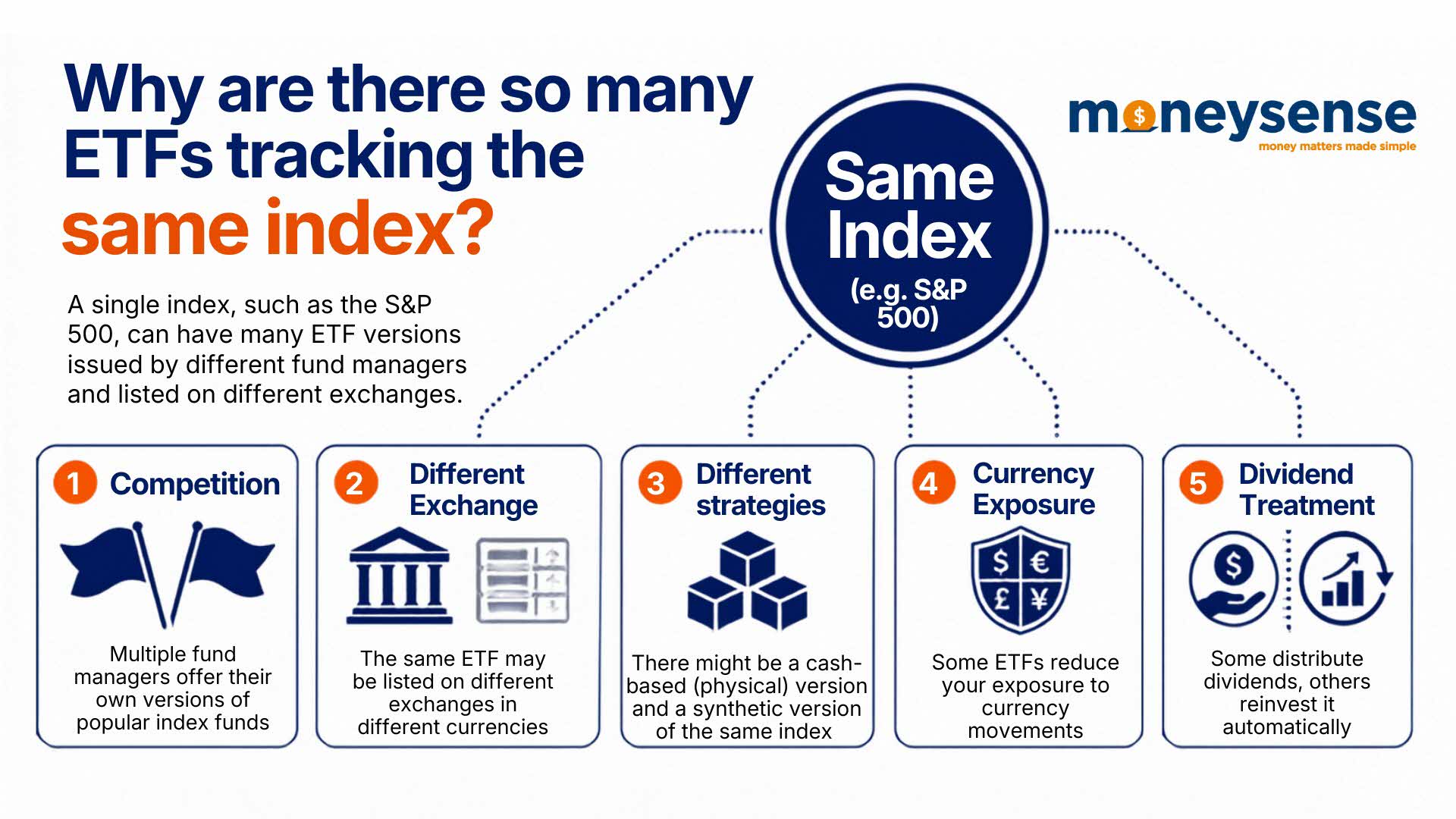
It can be bewildering to discover that a single index — say, the S&P 500, which tracks the 500 largest companies listed in the United States — has dozens of ETFs tracking it. They are issued by different fund managers and listed on different exchanges. Why does this happen?
Competition: Multiple fund managers compete for investor assets by offering their own version of a popular index fund, typically trying to differentiate on cost, strategy, or features.
Different exchanges: The same ETF may be listed on multiple exchanges in different currencies to make it accessible to investors in different markets.
Different strategies: Fund managers may offer both a cash-based (physical) version and a synthetic version of the same index.
Different currency exposure: Some ETFs reduce your exposure to currency movements. For example, if an ETF is priced in USD but you invest in SGD, a currency-hedged version would reduce your exposure to movements in USD/SGD exchange rates.
Different dividend treatment: Some ETFs distribute dividends to investors; others reinvest them automatically. This “distributing vs accumulating” choice affects how returns are delivered.
The key dimensions to compare
1. Total Expense Ratio (TER)
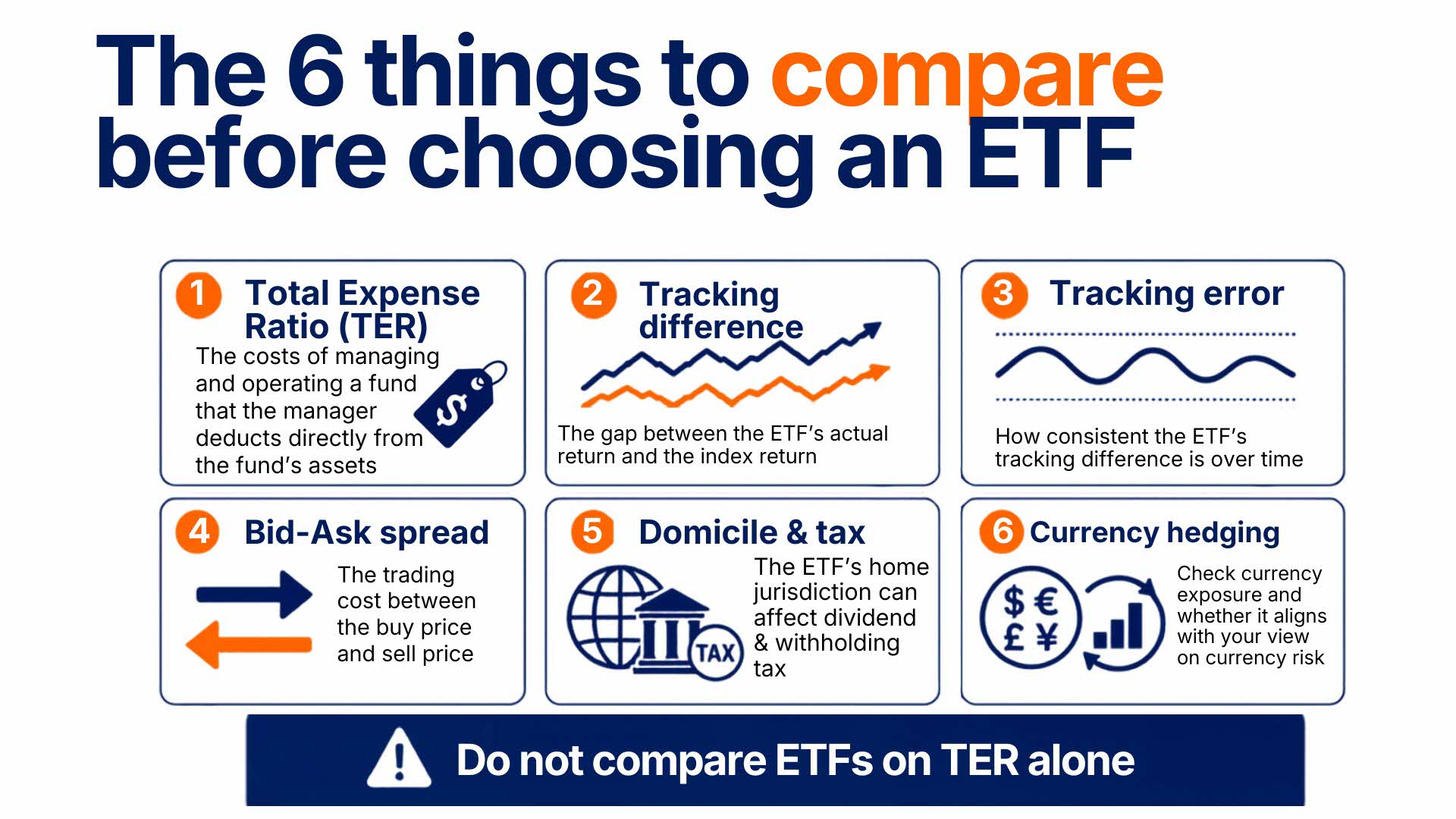
The TER is the annual cost of the fund, expressed as a percentage of assets under management and deducted directly from the fund’s assets. It covers the fund manager’s fee and other fund-level expenses. For similar ETFs tracking the same index, the TER can range from as low as 0.03% to over 0.5% of the net asset value (NAV) of the ETF per annum.
On a $50,000 investment over 20 years, the difference between a 0.1% TER and a 0.5% TER — all else equal — compounds to thousands of dollars of foregone returns. For passive ETFs that track the same index, their portfolios are essentially identical. All else being equal, the one with the lower TER is almost always better.
2. Tracking difference and tracking error
Two related but distinct concepts:
Tracking difference: The gap between the ETF’s actual return and the return of the index it tracks, over a specified period. A negative tracking difference means the ETF underperformed the index; a positive one means it outperformed. Tracking difference incorporates the TER but also reflects the efficiency of the manager’s replication method. A lower TER does not always mean a smaller tracking difference.
Tracking error: The consistency of the tracking difference over time. An ETF with a less consistent tracking difference — even if the average is small — is less predictable.
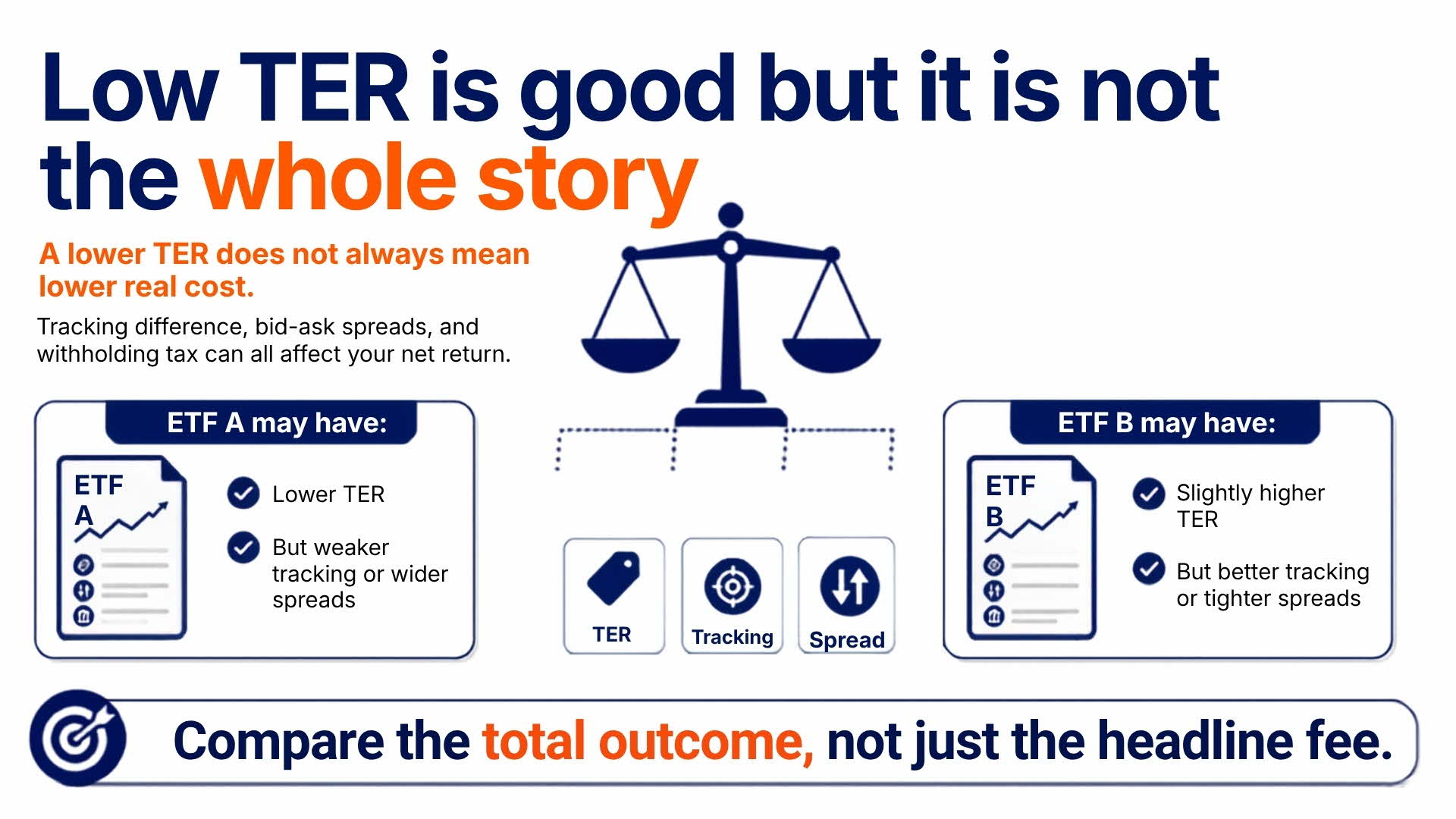
When comparing ETFs, tracking difference can supplement TER. An ETF with a 0.3% TER but a smaller negative tracking difference may have delivered a better return than one with a 0.2% TER but bigger negative tracking difference.
3. “Bid-ask” spread and liquidity
When you buy or sell an ETF on the exchange, you pay a “bid-ask” spread — the difference between the price at which buyers will buy and the price at which sellers will sell. For very liquid ETFs with high trading volumes, this spread is tiny (often 0.01%–0.05%). For less liquid ETFs, it may be 0.5% or more.
If you are investing regularly, a wide spread is an ongoing cost that the TER does not capture.
4. Fund domicile and withholding tax
Where an ETF is legally domiciled (its home jurisdiction) affects how much withholding tax is deducted from dividends before they reach you. For example, an ETF domiciled in the US and held by a Singapore investor is subject to a 30% US withholding tax on dividends.
For a dividend-paying ETF, this difference in withholding tax treatment can meaningfully affect your net return, sometimes more than the difference in TER.
5. Currency hedging
A Singapore investor buying a USD-denominated ETF tracking US equities has two sources of return (or loss): the performance of US equities, and the movement of the USD against the SGD. Some ETFs offer a SGD-hedged version that uses financial instruments to reduce this currency exposure.
Whether hedging is worth the additional cost depends on your view of currency risk and your investment horizon. Short-term investors who are sensitive to short-term swings may wish to consider currency hedging. Long-term investors may have more time to absorb currency movements, though exchange-rate movements can still materially affect returns.
6. Distributing vs accumulating
A distributing ETF pays dividends or income directly to investors. For investors who want regular income from their portfolio, distributing ETFs are more suitable.
An accumulating ETF automatically reinvests those distributions back into the fund. For long-term investors in a tax-free or tax-deferred environment, accumulating ETFs can be more efficient as they avoid the drag of repeatedly reinvesting dividend payments at a small cost.
How to choose: A practical framework
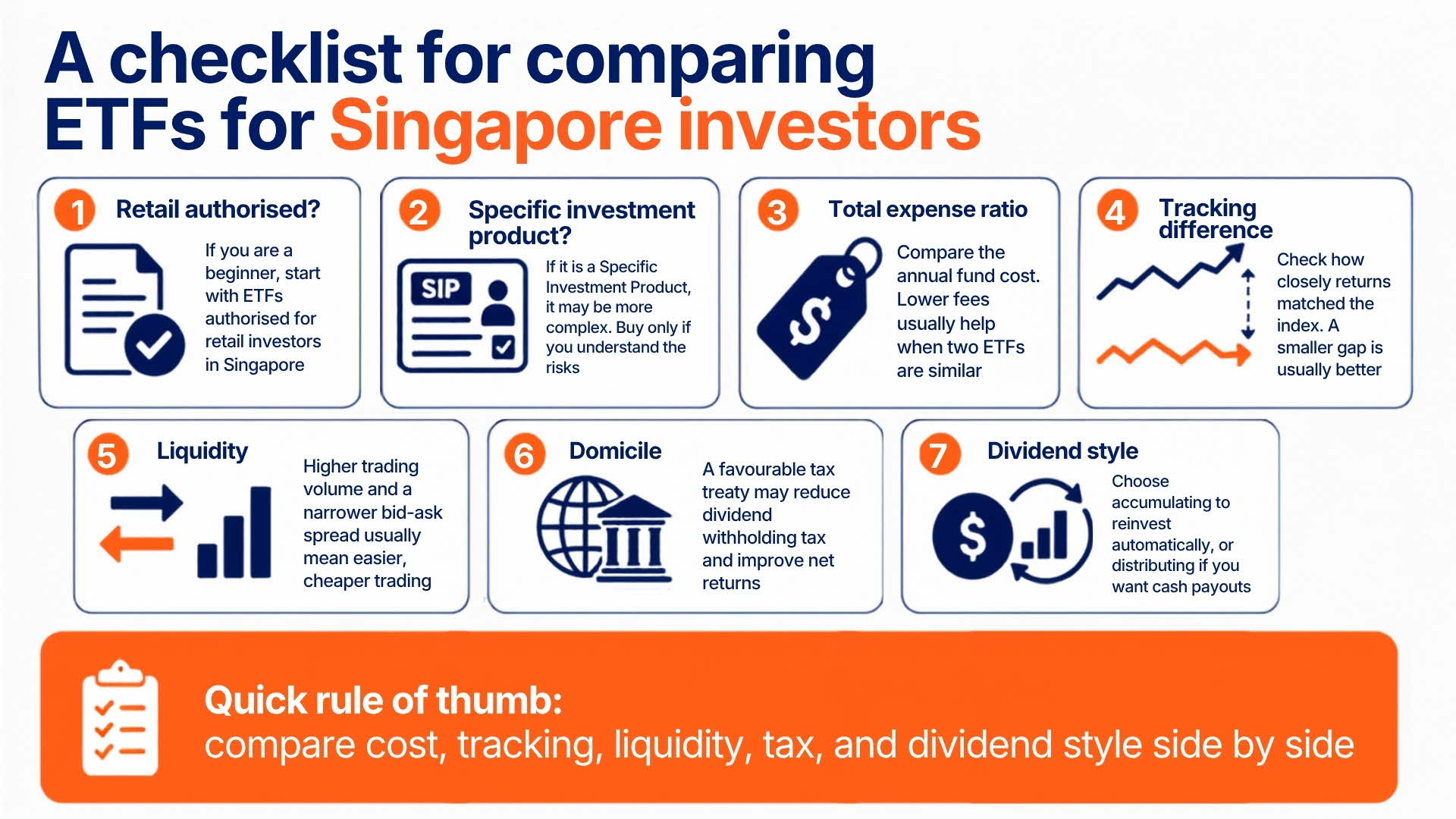
For most retail investors comparing ETFs tracking the same index, work through these questions in order:
Is the ETF authorised for sale to retail investors in Singapore? Check the MAS OPERA database (eservices.mas.gov.sg/opera (opens in new tab)).
Is it classified as a Specified Investment Product (SIP)? Check sips.abs.org.sg (opens in new tab). If yes, confirm with your broker whether you need to complete a Customer Account Review (CAR) before trading.
What is the TER? For passive index funds, prioritise lower TER, all else equal.
What is the tracking difference? Check the fund manager’s website for the annual tracking difference data. This tells you the real cost more accurately than TER alone.
What is the bid-ask spread? Check the average daily trading volume on the stock exchange and the typical bid-ask spread.
What is the domicile? Check whether it is domiciled in a jurisdiction with a favourable dividend withholding tax treaty.
Does it distribute or accumulate? Match this to your income or reinvestment preference.
Do you need multiple ETFs tracking the same index?
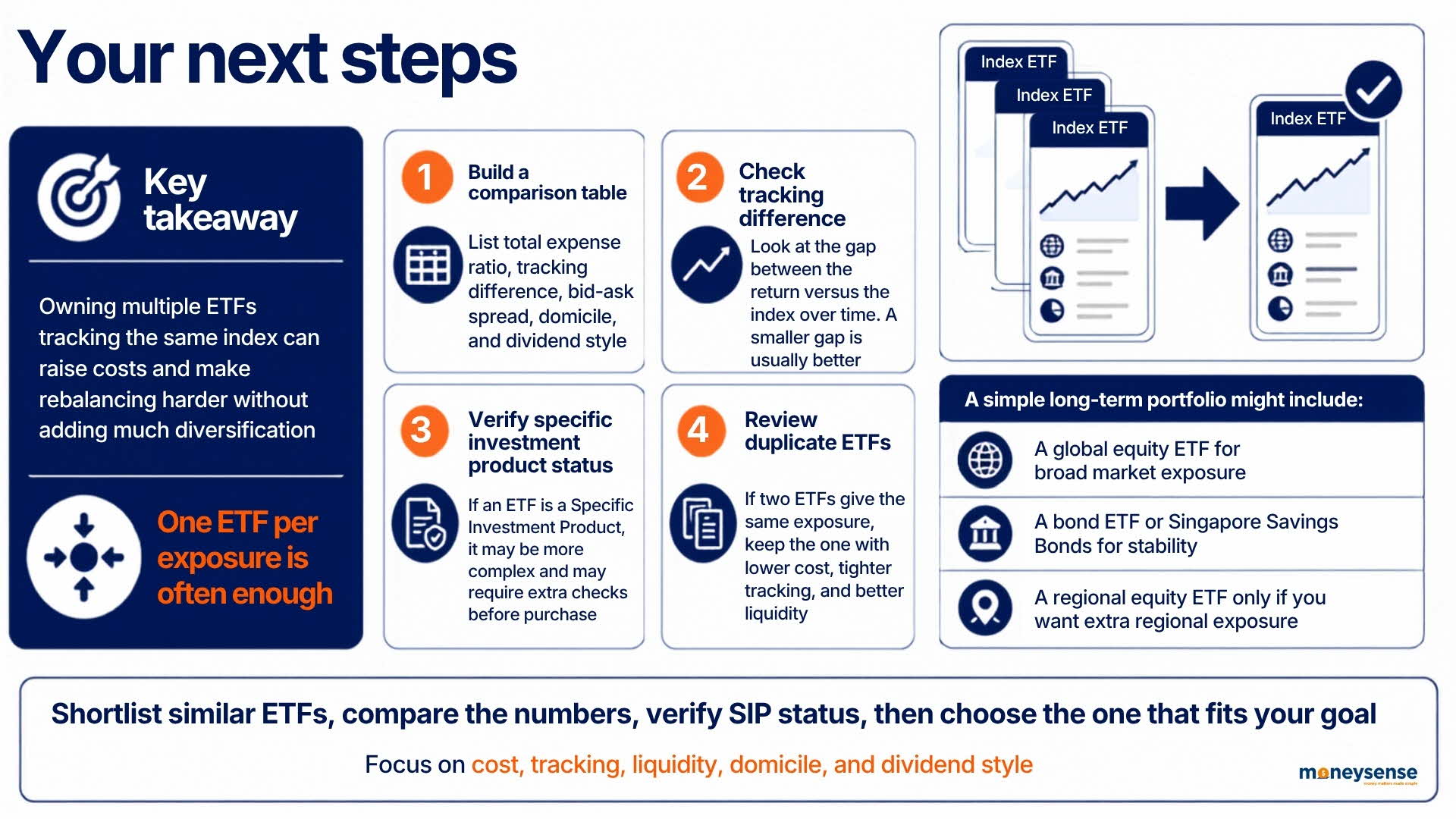
Almost certainly not. For a given exposure — say, global equities or Singapore equities — you only need one ETF. Holding multiple ETFs tracking the same index adds complexity, multiplies trading costs, and makes rebalancing harder, without meaningfully improving diversification (since the portfolios are essentially identical).
A simple, diversified long-term portfolio for most Singapore retail investors might consist of:
One ETF tracking a global equity index for broad market exposure
One ETF tracking a bond index or an allocation to Singapore Savings Bonds for income and stability
Optionally, one ETF tracking a regional equity index if you want additional regional exposure
More funds than this rarely adds value and often increases complexity and cost.
Watch out for
Choosing an ETF based on TER alone without checking tracking difference. A fund with a higher TER may still deliver better net returns if it replicates the index more efficiently.
Ignoring “bid-ask” spreads for ETFs with low trading volumes. On an illiquid ETF, the spread may cost you more than a year of TER savings.
Buying multiple ETFs tracking the same index to “diversify within ETFs”. This creates unnecessary complexity without improving your diversification.
Overlooking withholding tax treatment. The difference in withholding tax can be significant for a dividend-paying ETF.
Your next steps
For any two ETFs tracking the same index that you are comparing, build a simple table: TER, tracking difference (last 12 months), average daily volume, domicile, and accumulating/distributing. The comparison will usually become clear.
Check the annual tracking difference — not just TER — for each ETF on the fund manager’s website or on a fund data provider like justETF or the SGX ETF screener.
Verify the ETF’s classification (SIP or non-SIP) at sips.abs.org.sg (opens in new tab) before placing any order.
If you hold two or more ETFs tracking the same index, consider consolidating into the one with the lower tracking difference and better liquidity.
For an overview on how to choose between ETFs that track the same index
Frequently asked questions (FAQ)
Why are there so many ETFs tracking the same index?
Multiple fund managers compete for investor assets by offering their own version of a popular index fund (like the S&P 500 or MSCI World). The same index can have ETFs listed on different exchanges, in different currencies, with different strategies (cash-based or synthetic), different currency hedging arrangements, and different dividend treatments (accumulating vs distributing). Each variation serves a different investor preference.
What is tracking difference and why is it more useful than TER?
Tracking difference is the actual gap between an ETF's return and the return of its index over a specified period. It reflects the TER, but also factors in how efficiently the manager replicates the index. An ETF with a higher TER but very efficient execution may have a smaller negative tracking difference — and therefore deliver better returns — than one with a lower TER but poor execution. Check tracking difference on the fund manager's website alongside TER.
What is the difference between a distributing and an accumulating ETF?
A distributing ETF pays dividends or income directly to investors. An accumulating ETF automatically reinvests distributions back into the fund. For long-term investors who do not need the dividends as a regular stream of income, accumulating ETFs can be more efficient — they avoid the cost and friction of repeatedly reinvesting small dividend payments. For investors who want regular income, distributing ETFs are more suitable.
Do I need multiple ETFs tracking the same index?
Almost certainly not. For any given market exposure — say, global equities or Singapore equities — you only need one ETF. Holding multiple ETFs tracking the same index adds complexity, multiplies trading costs, and makes rebalancing harder, without meaningfully improving diversification (since the portfolios are essentially identical). A simple long-term portfolio for most Singapore retail investors may need only two or three ETFs in total.
What is a “bid-ask” spread and does it matter when choosing an ETF?
The “bid-ask” spread is the difference between the price at which buyers will buy and the price at which sellers will sell an ETF on the exchange. For very liquid ETFs with high trading volumes, the spread is tiny (0.01%–0.05%). For less liquid ETFs, it may be 0.5% or more. If you invest regularly, a wide spread is a real ongoing cost that does not appear in the TER. Always check the typical bid-ask spread before choosing between ETFs.
Related articles
Guide to ETFs: Understanding Exchange-Traded Funds
ETFs offer diversification at low cost—but not all are the same. Understand how ETFs track indices, their liquidity advantages, and how they compare to unit trusts in Singapore.
Guide to ETFs: How synthetic ETFs work
Synthetic ETFs deliver index returns through derivatives, not actual holdings—and that creates risks. Understand counterparty risk and collateral arrangements before investing.
Unit trusts: Guide to pricing and fees
Choosing the wrong unit trust is an expensive mistake. This comprehensive guide helps Singaporeans compare funds, understand costs, and build a diversified portfolio that makes sense.