
Life stage investing: Is it for me?
How should I manage my investments as I get older? A guide to life stage investing in Singapore.
Last updated on 15 September 2026

Key takeaways:
Life stage investing involves adjusting your asset allocation over time — typically shifting from higher-risk growth assets when you are young to lower-risk income assets as retirement approaches.
Younger investors have more time to recover from market downturns, while older investors have a shorter investment time horizon and a lower capacity to absorb losses.
If you are comfortable with actively managing your own asset allocation, you do not need a specialised product to follow a life stage approach. You can do it yourself by reviewing and adjusting your portfolio’s asset mix over time.
Life stage investing is a useful framework, but it is not one-size-fits-all. Consider your investment goals, risk appetite, income stability, cash and CPF savings, and personal circumstances before you start investing.
What is life stage investing?
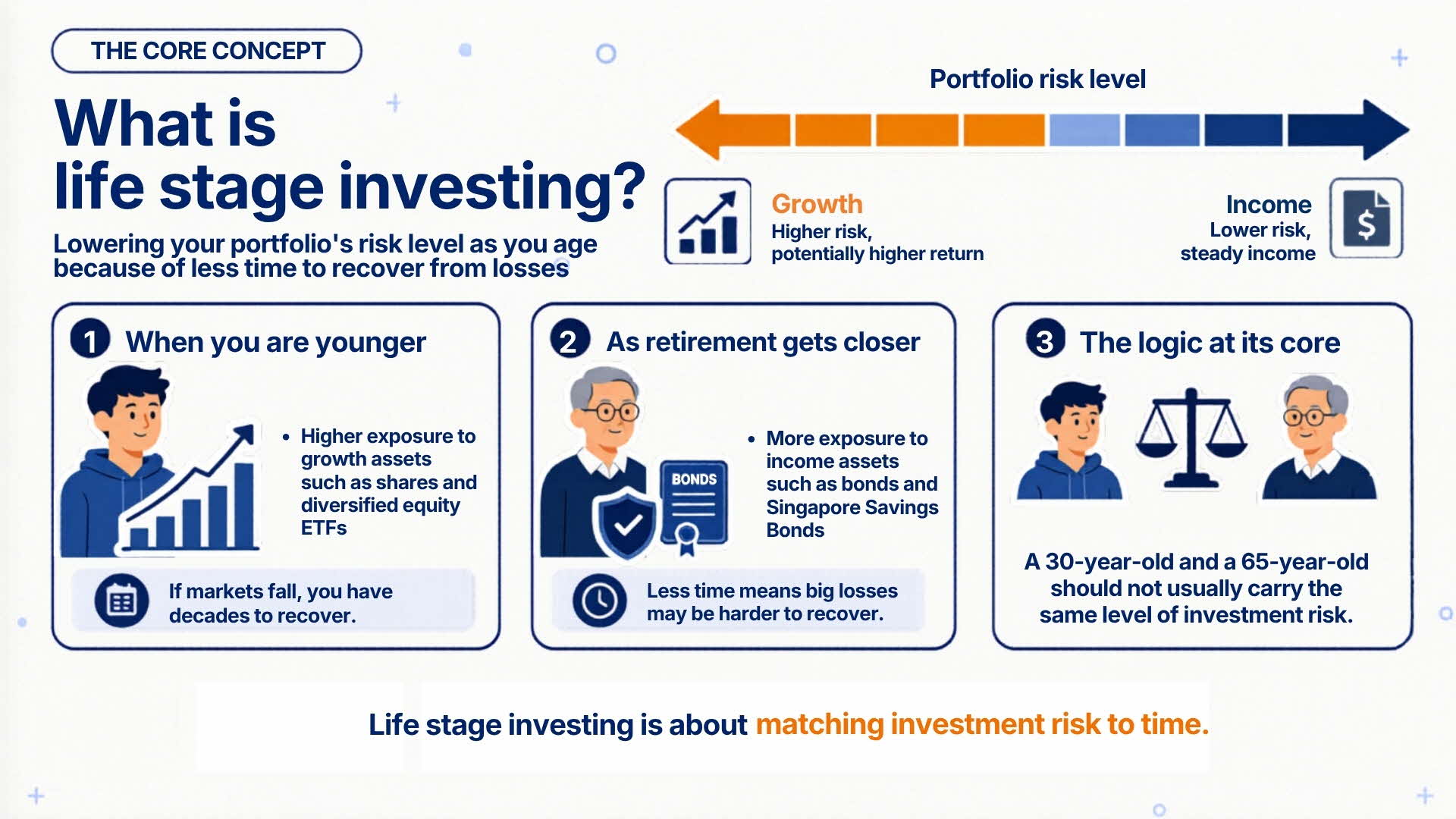
Life stage investing is an investment approach where you gradually adjust your portfolio’s risk level as you age. In simple terms, when you are young and decades away from retirement, your portfolio is weighted heavily toward growth assets such as equity, which offer higher potential returns but greater volatility. As you approach retirement, you gradually shift toward more stable, income-generating assets such as bonds, which typically offer lower returns but help preserve capital if you hold the bonds to maturity.
The underlying logic is about time: A 30-year-old who experiences a 40% market crash has two or three decades for the portfolio to recover. A 65-year-old who experiences the same crash may already be drawing down their portfolio. The amount of risk they can each afford to take is therefore very different.
Life stage investing tools available in Singapore
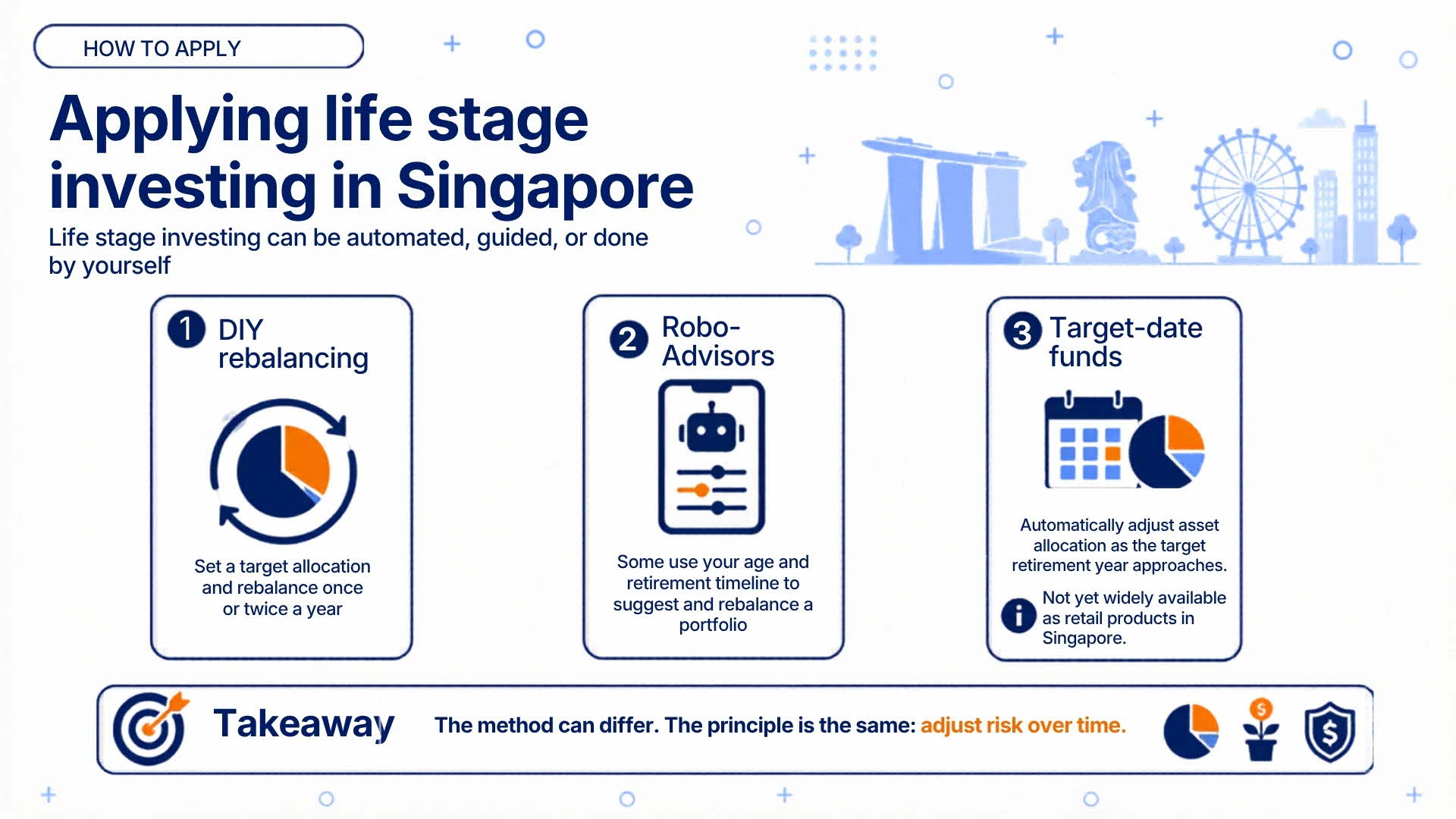
Target-date funds (life stage funds)
A target-date fund is a single fund product that automatically adjusts its asset allocation as it approaches a specified target date — usually a retirement year. For example, a “Retirement 2045 Fund” starts with a high equity allocation and gradually shifts towards bonds as 2045 approaches. The investor does not need to rebalance manually.
Target-date funds are not yet widely available as retail products in Singapore, although some MAS-licensed brokers offer them.
Robo-advisors with age-based rebalancing
Several Singapore robo-advisors ask for your age and retirement timeline during onboarding and will suggest a portfolio that reflects life stage principles. Some also automatically reduce equity exposure over time. This is the most accessible way for many Singapore retail investors to implement a life stage approach without making ongoing allocation decisions themselves.
Doing it yourself through rebalancing
If you are comfortable and wish to actively manage your own asset allocation, you can implement life stage investing without any specialised product. Start by establishing a target asset allocation appropriate for your age, risk profile and financial circumstance (using the 100 or 120-minus-age rule as a starting point), and then rebalancing at regular intervals — typically once or twice a year — to maintain that allocation and gradually adjust it over time.
Alternatives to a pure life stage approach
Life stage investing is widely used, but it is not the only valid approach. Depending on your investment goals and financial circumstances, you may find one of the following alternatives or a combination of them, better suited to your needs:
Alternatives for life stage investing
Risk-based allocation | Rather than adjusting by age, you adjust your portfolio based on your personal risk capacity — including financial resilience, liquidity needs, income stability, and tolerance for losses. Some investors in their 60s have sufficient stable income and CPF LIFE payouts to maintain a high equity allocation throughout retirement. |
Income-based investing | Building a portfolio designed to generate a stable income stream (e.g. dividends, bond coupons, REITs), rather than converting growth assets to income over time. |
Goals-based allocation | Matching each pool of savings to a specific goal (e.g. housing, children’s education, retirement) and applying the appropriate risk level to each pool independently, rather than managing one aggregate life stage portfolio. |
CPF + investment portfolio combination | Treating CPF savings (OA, SA, and eventually CPF LIFE payouts) as the conservative, guaranteed portion of your investment portfolio, and investing the remainder of your savings more aggressively throughout life. This is a form of investment approach that many Singaporeans already follow implicitly. |
Additional streams of income after retirement
CPF Lifelong Income for the Elderly (CPF LIFE) and voluntary CPF contributions
CPF LIFE is Singapore’s national longevity insurance annuity scheme. The more you contribute to your CPF account during your working years, the higher your eventual CPF LIFE monthly payouts will be. Making consistent contributions and having lifelong monthly payouts at retirement are effectively a built-in life stage mechanism that provides a stable baseline income for retirement. You can also make voluntary top-ups to your Retirement Account or Special Account (which earns 4% per annum) to build retirement savings and complement a life stage approach.
Annuities
Annuities are insurance products that provide a regular income stream, either for a fixed period (term annuities) or for life (life annuities). By paying a lump-sum or periodic premium to an insurer, you receive guaranteed monthly payouts — making them a useful tool for structuring retirement income.
Life annuities in particular protect against the risk of outliving your savings, as payouts continue regardless of how long you live. When choosing a participating annuity, it is worth noting that while the guaranteed component is fixed, any bonuses are dependent on the insurer's fund performance and are therefore not guaranteed.
Is there a right age to invest?
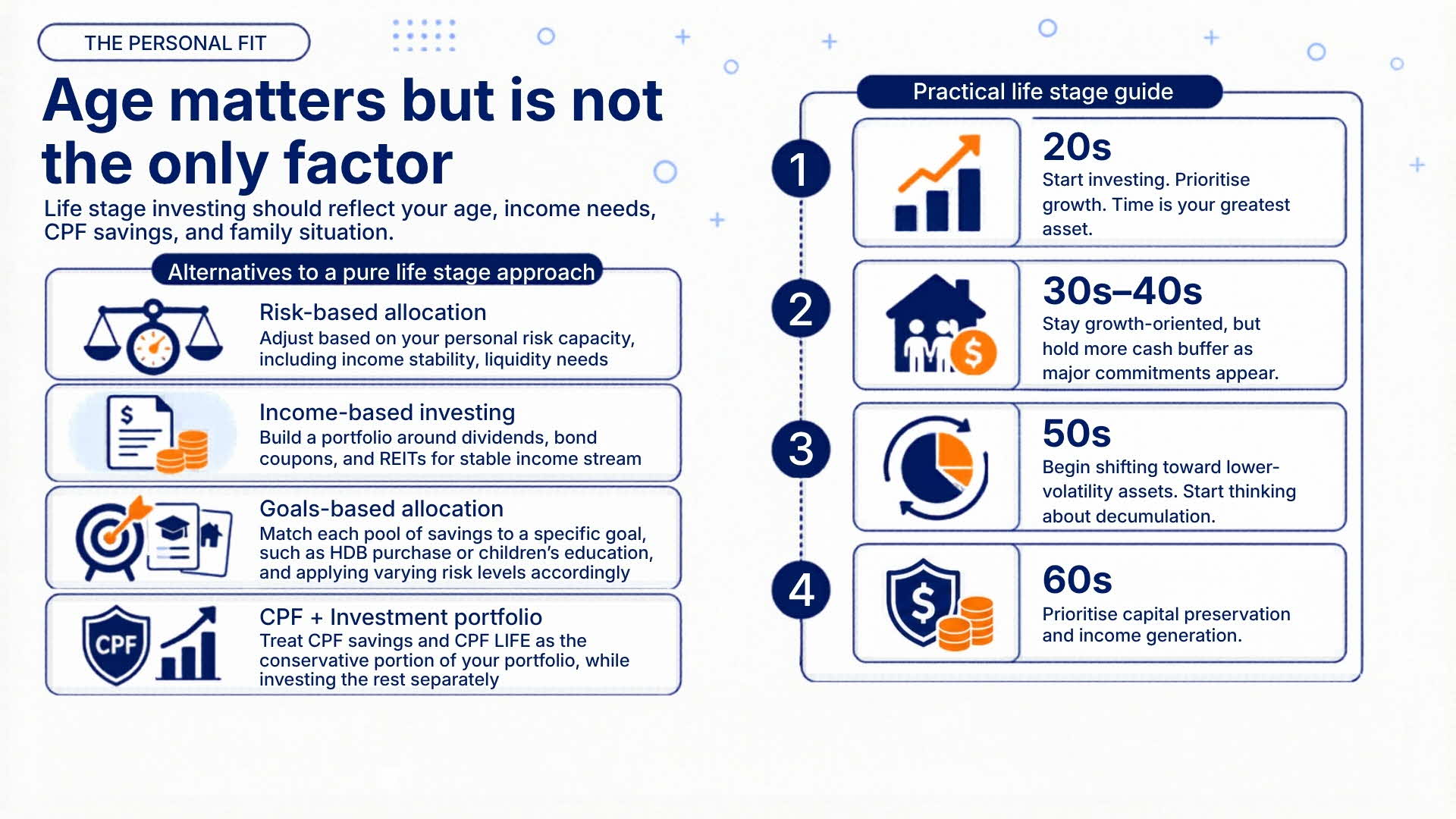
There is no single right age — but earlier is generally better, as it gives your portfolio more time to ride out market cycles and benefit from the power of compounding returns. The key insight of life stage investing is that your appropriate risk-return profile changes over time. Adopting a life stage framework early does not mean you take no risk, it means taking the right level of risk at different stages of life.
A practical way to think about it:
In your 20s: Start investing, prioritise growth, and keep equity allocations high. Time is your greatest asset.
In your 30s-40s: As financial commitments (e.g. HDB mortgage, children, ageing parents) increase, maintain a growth orientation but build a larger cash buffer. Review your allocation every two to three years.
In your 50s: Begin the deliberate shift towards lower-volatility assets. Start thinking about decumulation – how will you draw down your savings in retirement. Consider increasing your CPF savings through voluntary top-ups where possible.
In your 60s: Focus on capital preservation and income generation. Your equity allocation should reflect how much volatility your income and lifestyle can support.
Your next steps
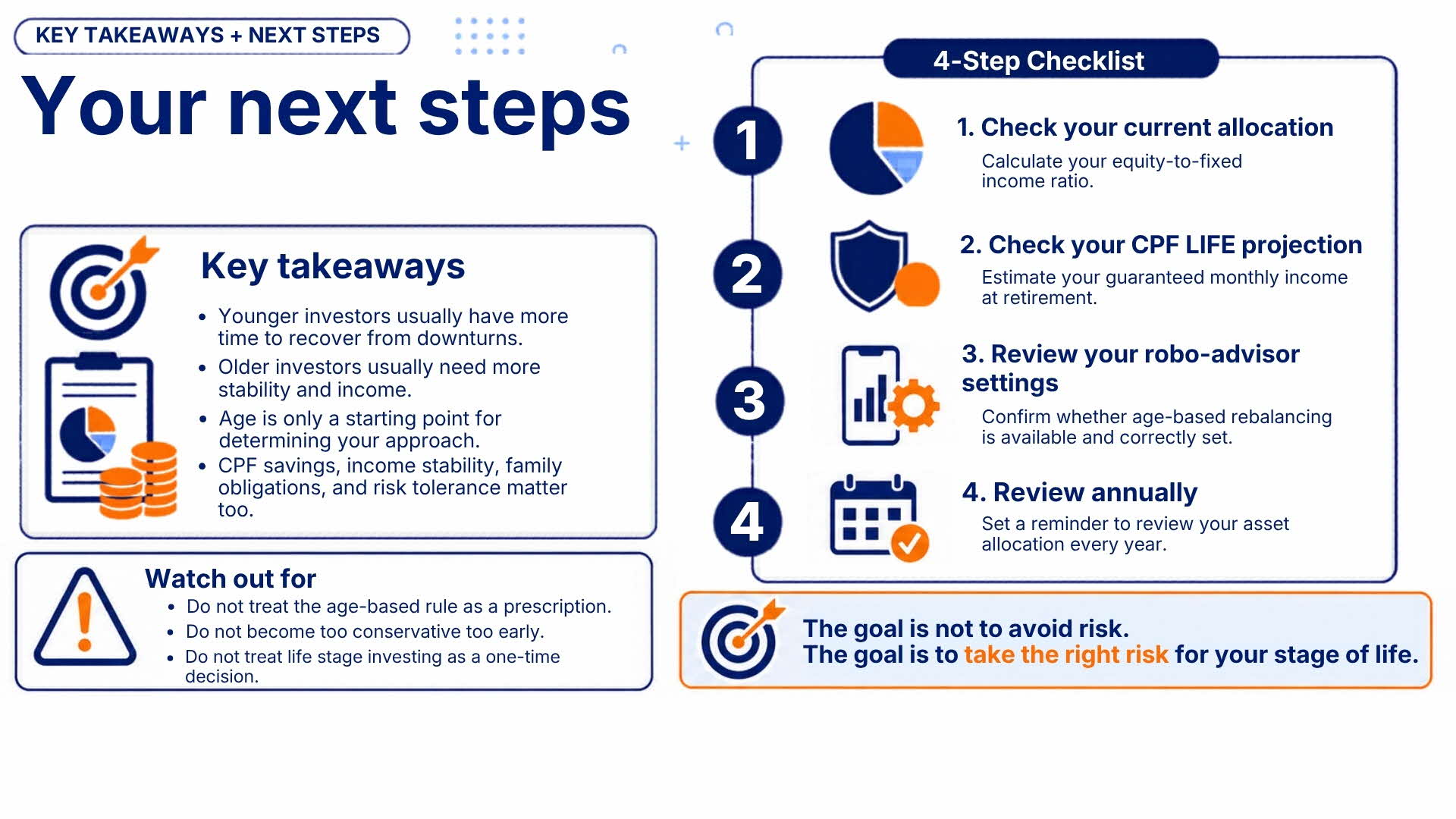
Calculate your current portfolio’s equity-to-fixed income ratio. Compare it to what a life stage framework appropriate for your age would suggest. Is there a meaningful gap?
Find out your projected CPF LIFE monthly payouts at cpf.gov.sg/retirementplanner (opens in new tab). This represents guaranteed income — compare it with your estimated monthly retirement expenses to identify any gap your investment portfolio needs to fill.
If you use a robo-advisor, check whether it offers age-based rebalancing and whether your target retirement date is set correctly.
Set an annual reminder to review your asset allocation — even if you use a life stage product — to confirm if it matches your current circumstances.
Watch out for
Treating the age-based rule of thumb as a precise prescription. It is a starting framework – adjust it for your individual circumstances, including income stability, cash and CPF savings, family obligations, and risk tolerance.
Shifting too aggressively towards conservative assets too early. A 55-year-old who moves entirely to cash and bonds may underperform inflation over a 30-year retirement, leaving them worse off in real terms.
Treating life stage investing as a one-time decision. It requires regular review and rebalancing, not just an initial allocation.
For an overview on life stage investing
Frequently asked questions (FAQ)
What is life stage investing?
Life stage investing means systematically adjusting your portfolio's risk level as you age — typically shifting from higher-risk growth assets (e.g. shares, equity ETFs) when you are younger, to lower-risk income and capital-preservation assets (e.g. bonds, Singapore Savings Bonds) as you approach retirement. The underlying logic is that younger investors have more time to recover from market downturns, while older investors have a shorter investment time horizon and lower capacity to absorb losses.
What is the “100 minus age” rule and should I use it?
The traditional rule of thumb is to subtract your age from 100 to estimate your equity allocation percentage (e.g., a 40-year-old may hold: 60% in equities, and 40% in bonds/cash). Due to longer life expectancies, many planners now use 110 or 120 as the base instead. But this is a starting framework, not a precise prescription — your actual allocation should also reflect your income stability, cash and CPF savings, family obligations, liquidity needs, investment time horizon and risk tolerance.
What are the alternatives to a life stage approach?
Alternatives include risk-based allocation (adjusting based on your personal risk capacity rather than age); income-based investing (building a portfolio that generates a stable income stream from dividends, bond coupons, and REITs); goals-based allocation (matching each savings pool to a specific goal with its own risk level); and the CPF + investment portfolio combination (treating CPF as the conservative portion and investing the rest more aggressively throughout life).
Is there a right age to start a life stage approach?
Earlier is generally better. At 25, a life stage framework means taking an appropriate level of risk for your situation — not taking no risk. In your 30s–40s, maintain growth orientation but begin building a larger cash buffer as major financial commitments increase. In your 50s, begin the deliberate shift toward lower-volatility assets. In your 60s, capital preservation and sustainable income become the priorities.
Related articles
Putting together an investment portfolio
A good portfolio doesn’t manage itself. Learn how to diversify, allocate assets, rebalance strategically, and keep your Singapore investments aligned with your real financial goals.
What you need to know to take care of your investment portfolio
Buying investments is the easy part—maintaining them is what most investors find challenging. Learn to review, rebalance, and make rational decisions without letting emotions take over.
What to ask when buying an investment product
Never let enthusiasm replace due diligence. Use this essential checklist—covering fees, risks, liquidity, and adviser credentials—before putting your money into any investment product.