
Behavioural science and investing
How do cognitive biases and emotions affect investing? What can I do about it?
Last updated on 21 September 2026
Key takeaways
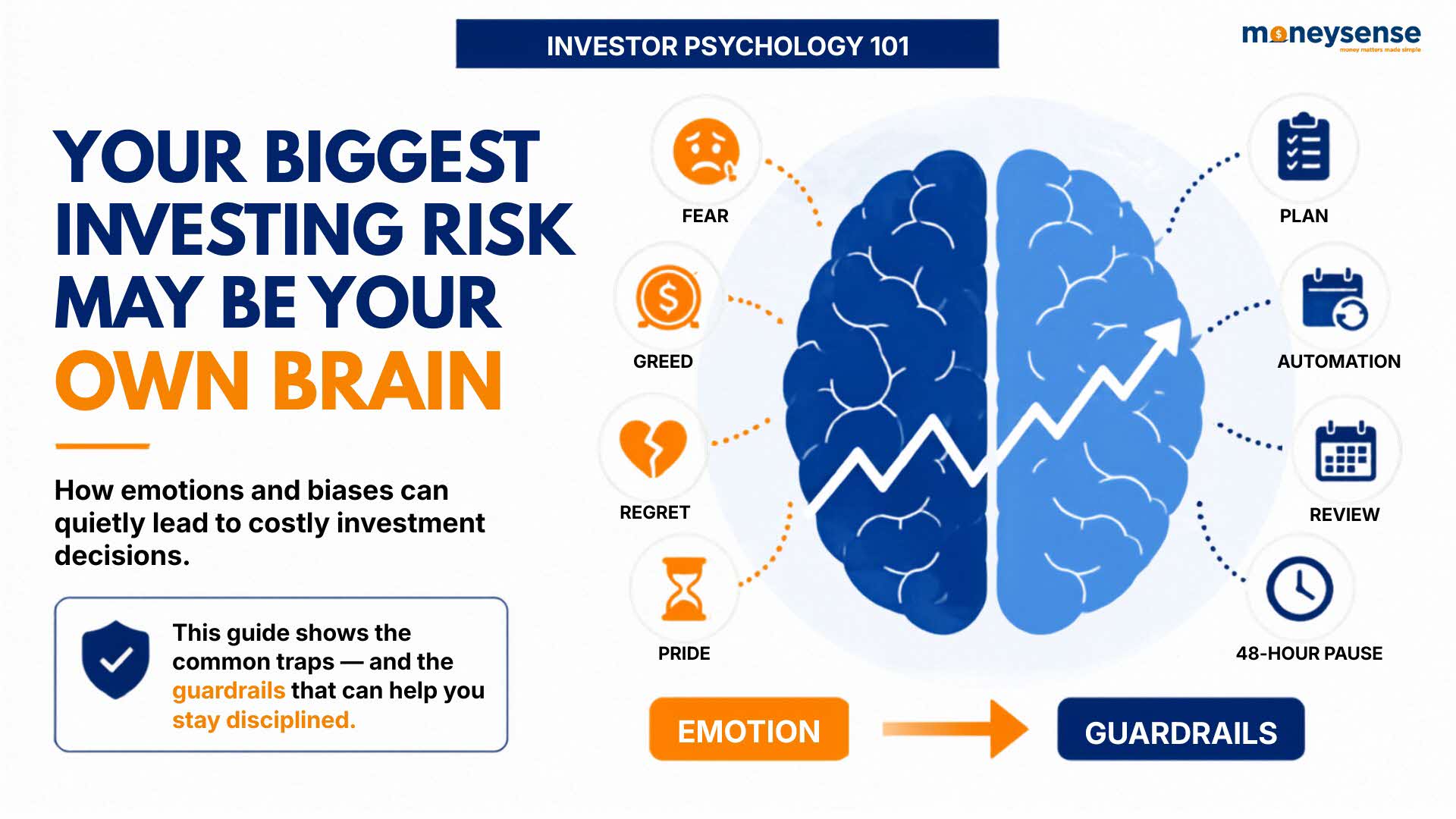
Psychological biases lead even experienced investors to make costly mistakes.
Writing down your rules, automating contributions, and scheduling regular reviews keeps emotions out of your investment decisions.
Why behavioural science matters in investing
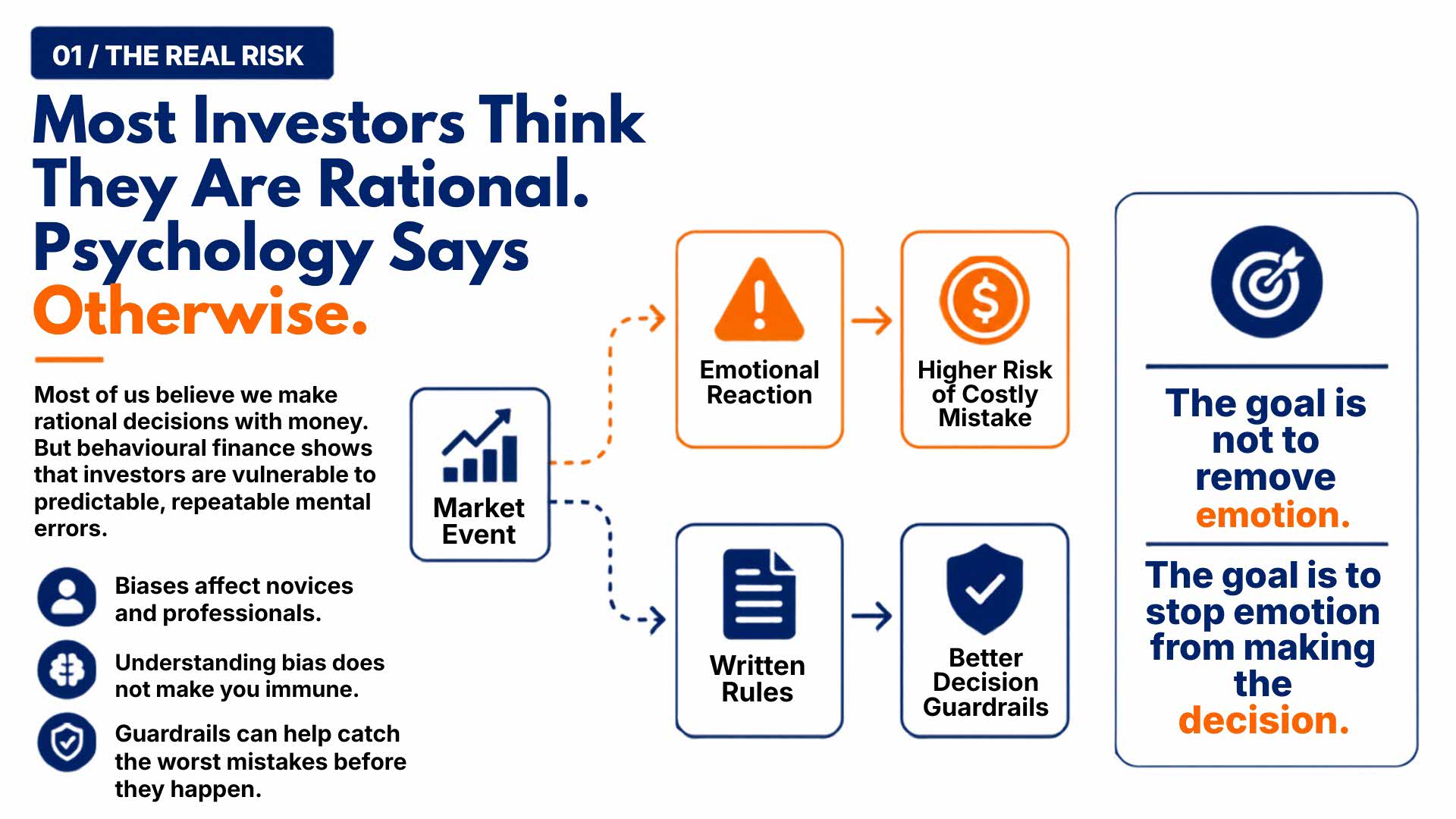
Most of us believe we make rational decisions with money. However, decades of studies in behavioural finance show that investors, from novices to professionals, can be susceptible to predictable, repeatable mental errors.
Understanding these biases does not make you immune to them. But it can help you build guardrails that catch mistakes before they happen.
Common psychological biases that affect investors
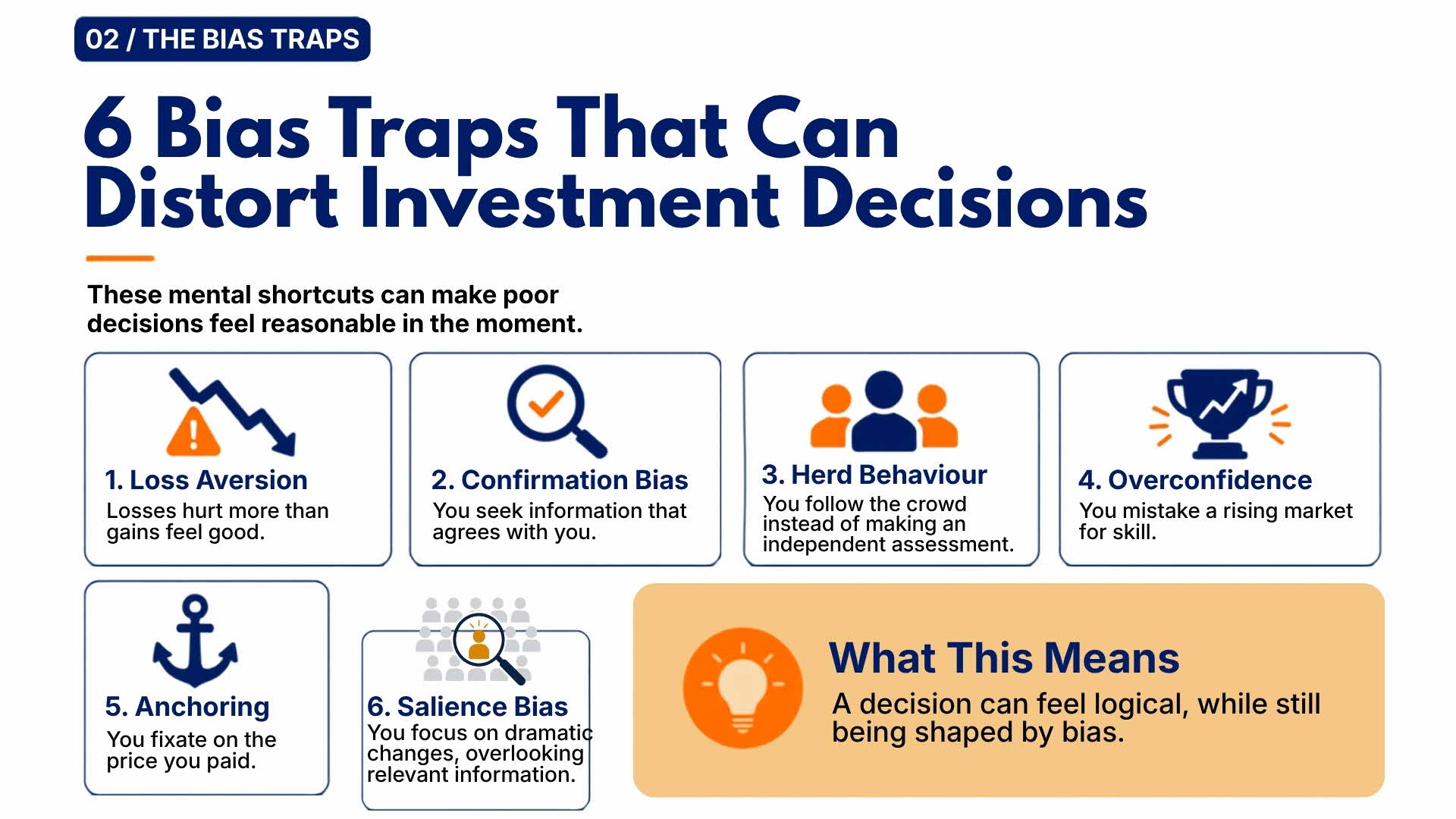
Loss aversion: losses hurt more than gains feel good
When you lose $1,000, it will likely feel roughly twice as powerful as the pleasure of gaining $1,000. This is loss aversion. In practice, it causes investors like us to:
Hold on to losing investments for far too long, hoping to “break even”, even when the investment case has clearly deteriorated
Sell winning investments too early to “lock in” the gain before it disappears
Avoid making any investment at all, because the fear of loss outweighs the potential for gain
Confirmation bias: seeking information that you agree with
Once we form an opinion on something, we tend to seek out information that confirms it and dismiss information that challenges it. The credibility of prestigious institutions such as top investment firms can intensify this effect, as we may pay greater attention to information that confirm what we already believe about an investment. This causes us to become overconfident and excessively optimistic in our views, such that we might miss warning signs.
Anchoring: Fixating on an irrelevant number
Anchoring is the tendency to rely too heavily on the first piece of information we receive, even if it is not particularly relevant. In investing, this often manifests as fixating on the purchase price as a reference point, even when it does not really help in predicting an investment’s future prospects.
Salience bias: Overweighting what stands out most
When evaluating stocks, everyday investors may overweight information that stands out, such as an unusually large gain or a dramatic crash. At the same time, we may underweight mundane but financially relevant information. Thus, if a particular stock is catching your attention because of how dramatic or prominent its trading history appears, treat that heightened interest as a signal to pause and examine the fundamentals rather than simply acting on that feeling.
Overconfidence: Mistaking a bull market for investing skills
When markets are rising, we often credit our own skill for good returns. When markets fall, we blame bad luck. This self-serving attribution contributes to overconfidence bias, where investors develop an inflated assessment of their own performance relative to others. It leads us to take on more risk than we realise, trade too frequently, and ignore the role of luck in our results.
Herd behaviour: following the crowd
When markets are rising sharply, it is uncomfortable to sit on the sidelines. When everyone around you is making money from a particular investment, the fear of missing out (FOMO) can be overwhelming. This contributes to herd behaviour, which is the “kiasu” tendency to follow what everyone else is doing rather than making an independent assessment.
Role of emotions
Cognitive biases rarely operate in isolation. Emotions further serve as a powerful amplifier, intensifying the pull of these biases and making them far harder to recognise or resist in the moment.
Rather than viewing them as separate forces, cognition and emotion are deeply intertwined as they reinforce each other in ways that compound their individual effects. Understanding this relationship is central to investing, as it helps us make sense of the “irrational” choices we make.
How emotions drive costly decisions
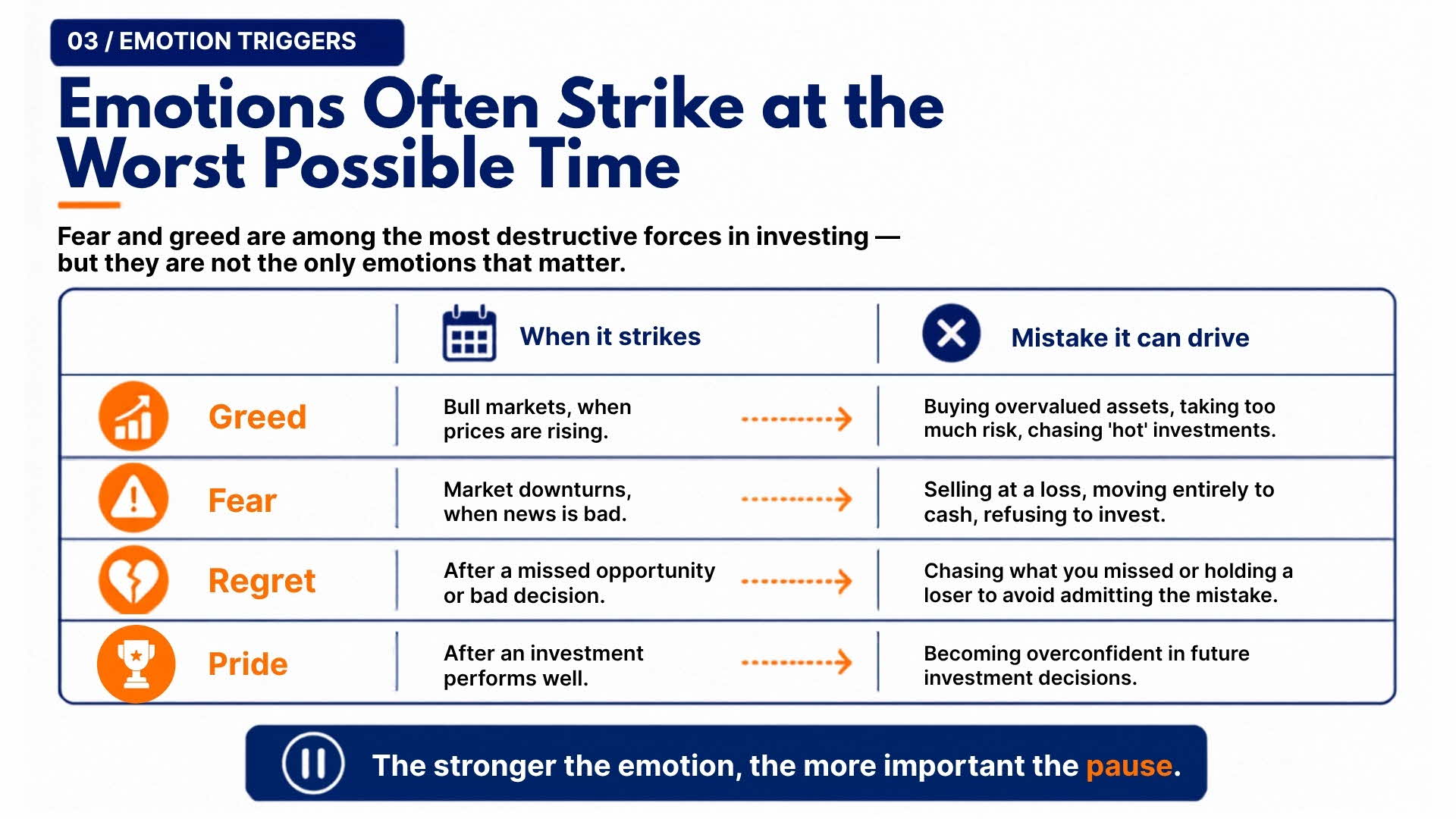
Emotions determine our tolerance for risk, which influences how we build our portfolio.
The most consequential emotions are fear and hope, which tend to pull us in opposite directions. Fear induces us to focus on events that are especially unfavourable, while hope induces us to focus on events that are favourable.
Other strong emotions that drive us include regret and pride.
Summary of how emotions may influence investment decisions
Possibilities | |
Fear: How badly can the investment perform?
| Hope: How well can the investment perform?
|
Post-decision accountability | |
Regret: The investment performed badly.
| Pride: The investment performed well.
|
Practical strategies to stay disciplined
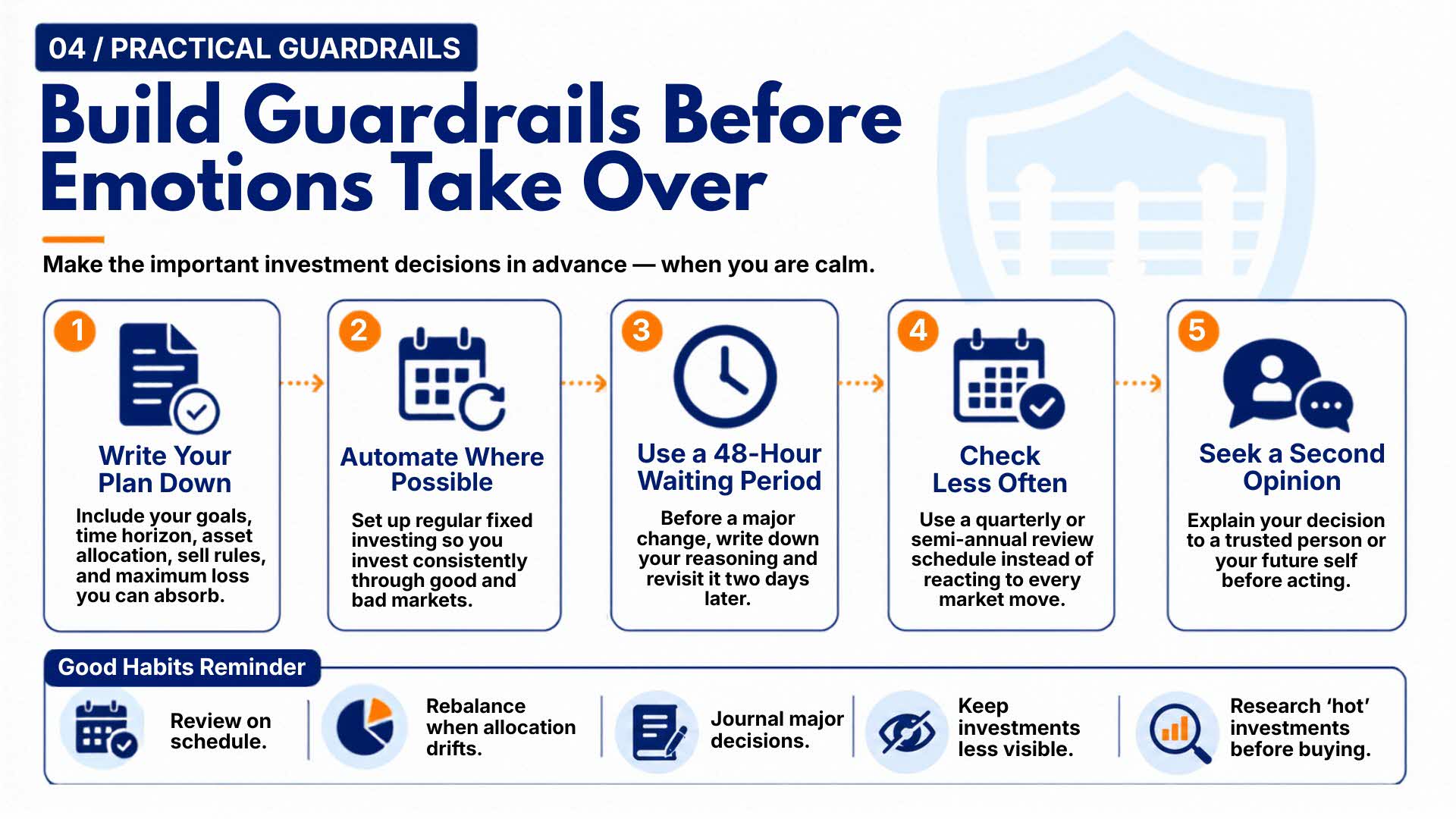
Write your investment plan down
A written investment plan is an effective guardrail against emotional decision-making. You can include your goals, your investment horizon, your asset allocation, the criteria under which you would sell an investment, and the maximum loss you can absorb without changing course.
When writing your implementation intentions, one useful phrasing would be “IF situation X appears, THEN I will do behaviour Y”. Review it before making any major investment decision.
Dollar Cost Averaging
Setting a fixed amount to invest at regular time intervals can help to remove emotion from the investing process. It may also reduce your exposure to temporary price fluctuations.
For example, a standing instruction to invest $500 monthly into a diversified ETF allows you to invest consistently through both good and bad times. You stop trying to time the market and start building wealth through time in the market.
Limit portfolio checks
The more frequently you monitor your portfolio, the more likely you are to see short-term losses and react emotionally. By reducing your frequency of checks, you can dampen the experience of negative emotions and avoid reacting too quickly to short-term movements.
Consider establishing a regular review schedule quarterly or half-yearly to build structure into your investment process.
Take a deliberate pause before major decisions
Before making any significant investment change, especially one driven by a market event or news story, take a deliberate pause to reduce emotion-driven decisions. This enables you to reflect on prior knowledge and perform a critical self-assessment on whether you need to find out more.
Many decisions that feel urgent in the moment look very different, after the immediate emotional intensity has passed.
Seek a second opinion for large decisions
When making a significant investment change, make sure you have a decision support system to check your decisions. This could be a trusted financial adviser who can help prevent overconfidence or provide counterarguments to challenge potential irrational thoughts. Articulating your reasoning out loud often reveals flaws that are invisible when the thinking is entirely internal.
Watch out for
Making investment decisions while emotionally charged, perhaps after a market crash, during a bubble, or immediately after a major personal event. Slow down and revisit practical strategies.
Treating paper gains as real money to be spent or reinvested aggressively. Until you sell, gains are unrealised and can disappear.
Using social media or online forums as your only source of information. These platforms amplify herd behaviour and overconfidence.
Confusing activity with progress. Trading frequently does not mean you are managing your portfolio better. It often means you are paying more in costs and making more emotional decisions.
Comparing your portfolio to someone else’s. They have different goals, timelines, and risk profiles. Comparison is the source of most investment FOMO.
Your next steps
Write a one-page investment policy statement for yourself: Your goals, your target asset allocation, and the conditions under which you would make a change. Keep it somewhere you can find during the next market downturn.
Set up a standing instruction through your bank or investment platform to invest a fixed amount automatically each month into a diversified product.
The next time you feel the urge to make an investment change based on news or market movement, write down your reasoning and take a deliberate pause to reflect before acting.
For an overview on behavioural science and investing
Frequently asked questions (FAQ)
What is loss aversion and how does it hurt investors?
Loss aversion is the psychological tendency for the pain of losing $1,000 to feel roughly twice as powerful as the pleasure of gaining $1,000. In practice, it causes investors to hold losing investments too long (hoping to “break even”), sell winning investments too early (to lock in gains), and sometimes avoid investing altogether. The relevant question for any holding is not “What did I pay?” but “Would I buy this today at the current price?”.
What is confirmation bias in investing?
Confirmation bias is the tendency to seek out information that confirms your existing view and dismiss information that challenges it. Once you have formed an opinion on an investment, you may read only positive analyst reports and skip critical ones. This causes investors to become overconfident and miss warning signs. Deliberately seeking out the bear case for any investment you hold is a practical defence.
What is herd behaviour and FOMO in investing?
Herd behaviour is following what everyone else is doing rather than making an independent assessment. FOMO (Fear Of Missing Out) is the anxiety of missing a rising investment. Together, they drive investors into overvalued assets near their peaks — cryptocurrency in 2021, dot-com stocks in the late 1990s.
What is anchoring bias and how does it affect investment decisions?
Anchoring is over-relying on the first piece of information you receive. In investing, the most common anchor is the price you originally paid. Investors refuse to sell a declining investment because they are waiting to “get back” to the purchase price. The market does not know or care what you paid — the only relevant question is: “Given what you know today, is this a good investment at the current price?”
How can I make better investment decisions under emotional pressure?
Practical strategies include writing a one-page investment plan before you invest (specifying goals, asset allocation, and conditions for selling); automating regular contributions through standing instructions; imposing a mandatory 48-hour waiting period before major investment changes; limiting portfolio-checking to quarterly rather than daily; and seeking a second opinion from a trusted person before large decisions. The goal is not to eliminate emotion — it is to make key decisions in advance when you are calm.
Why is checking your portfolio too often potentially harmful?
Research shows that investors who check their portfolios daily make more trades and achieve worse long-term returns than those who check quarterly. Frequent checking exposes you to short-term volatility, which triggers emotional responses — particularly loss aversion. Seeing a daily loss that would fully recover within a month can provoke a sell decision that locks in that loss permanently.
Does knowing behavioural biases make me immune to them when investing?
No, awareness may help to reduce bias but does not fully eliminate it. Many of these biases are largely automatic, not conscious reasoning errors that can be simply overridden. But knowing them allows us to deploy strategies to counteract these biases.
Related articles
Managing investment risk
Higher returns always come with higher risk—but which risks are you actually taking? Understand market, credit, liquidity, and currency risk before building your Singapore portfolio.
What to ask when buying an investment product
Never let enthusiasm replace due diligence. Use this essential checklist—covering fees, risks, liquidity, and adviser credentials—before putting your money into any investment product.
Before you follow “finfluencers”: How to spot red flags in financial content online
Before considering money tips on social media, know the risks. Learn how to spot red flags and evaluate finfluencer content to make informed financial decisions.