
Financial advisory process
Before you discuss insurance or investments with your financial adviser, learn about the process for analysing your needs and recommending products to you.
Last updated 14 September 2026
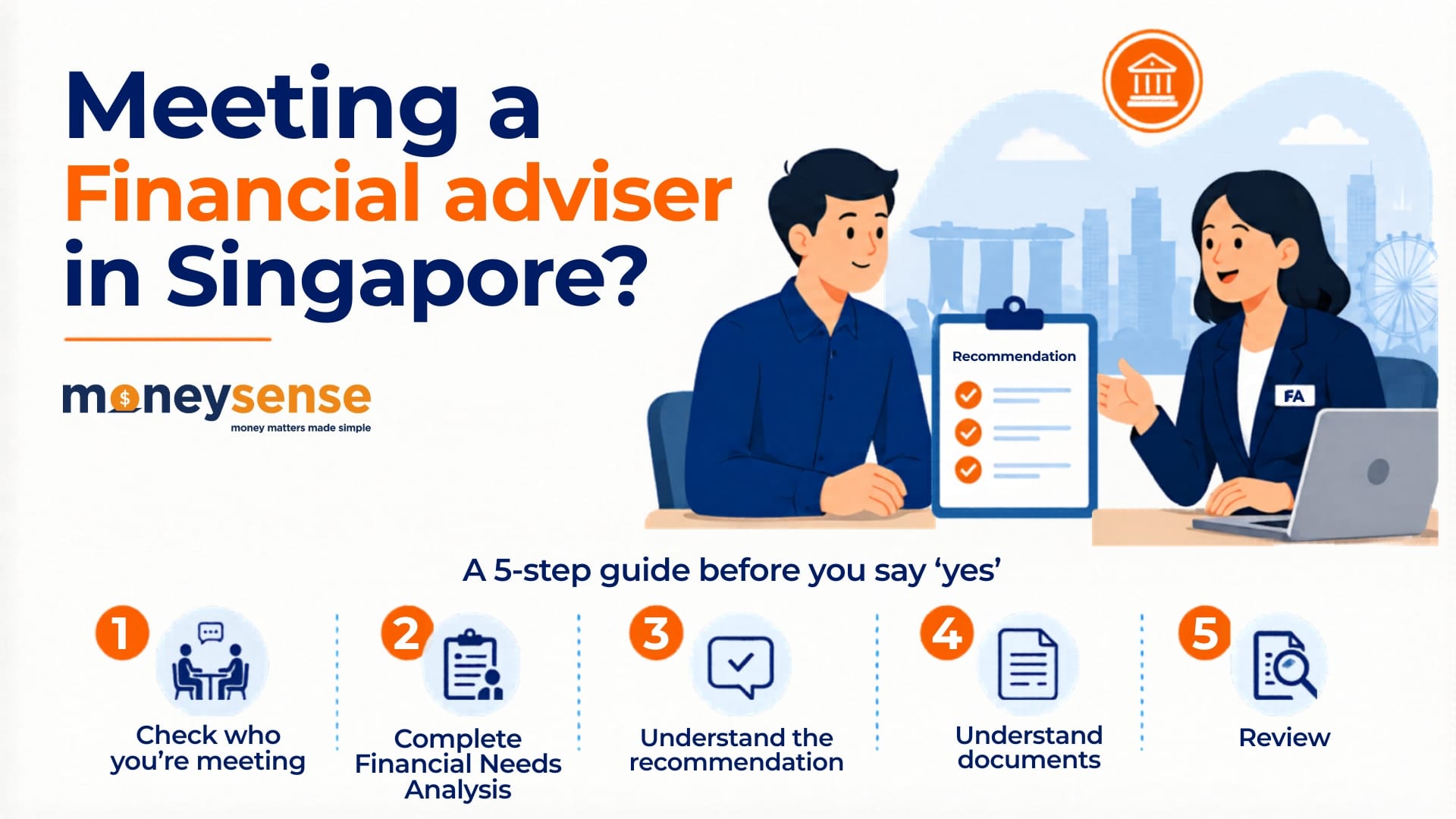
Key takeaways
Your Financial Advisory (FA) representative’s recommendations can only be as good as the information you provide. Be complete, honest, and accurate.
Understand what the product does, what it costs, and what you are committing to before agreeing to buy.
If a recommendation does not feel right, you are not obligated to accept it. Ask for an alternative.
Most products come with a free-look period — use it if you change your mind.
When you work with an FA representative, they are required to follow a structured process before making any recommendation. Understanding each step helps you participate effectively and protects your interests.
Step 1: Your first meeting
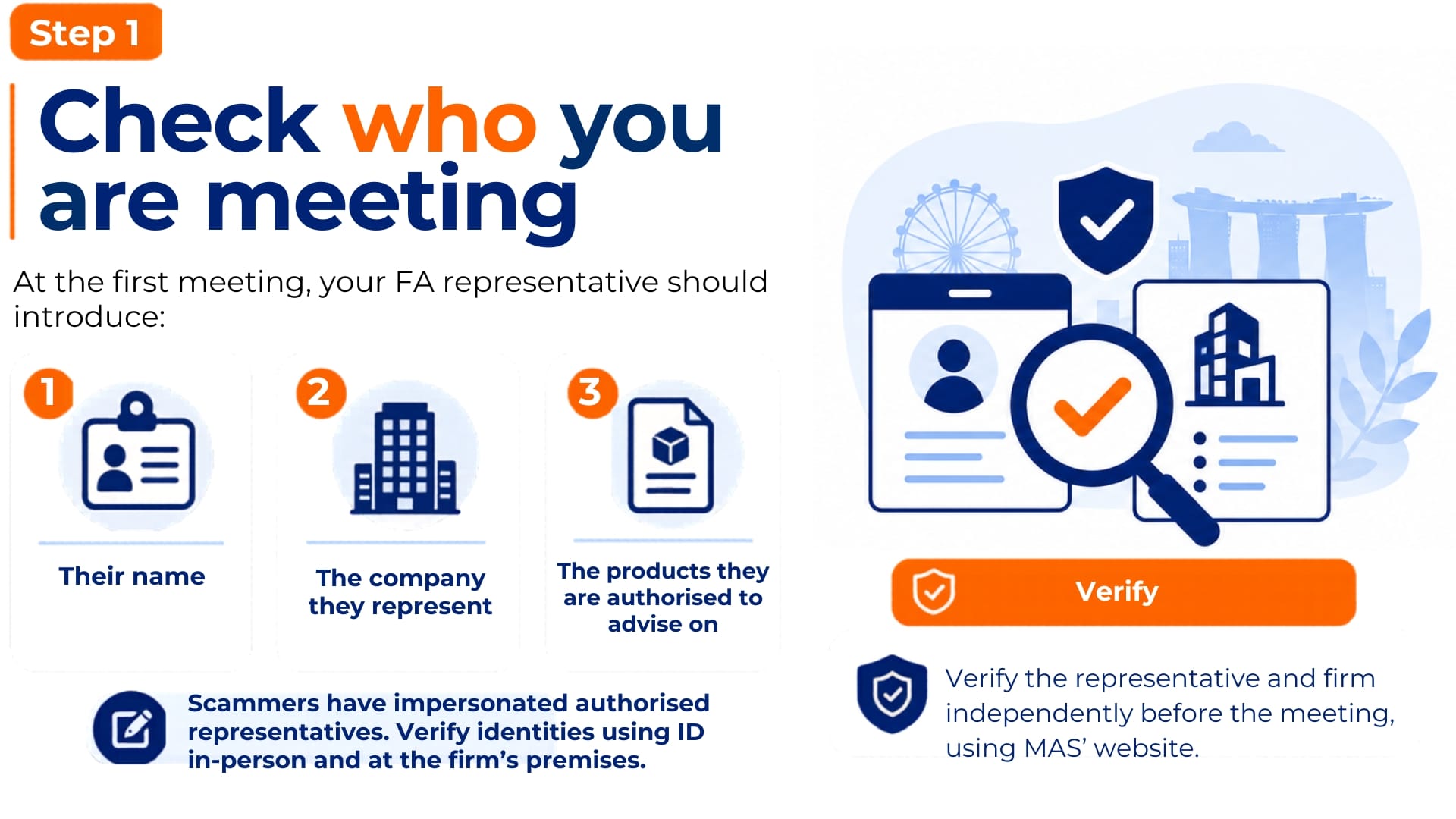
At your first meeting, your FA representative should tell you:
Their name
The company they represent
The types of products they are authorised to advise on
Make a note of this information and verify their credentials independently using eservices.mas.gov.sg/fid (opens in new tab) and eservices.mas.gov.sg/rr (opens in new tab). This should preferably be done before proceeding further.
Step 2: Financial Needs Analysis (FNA)
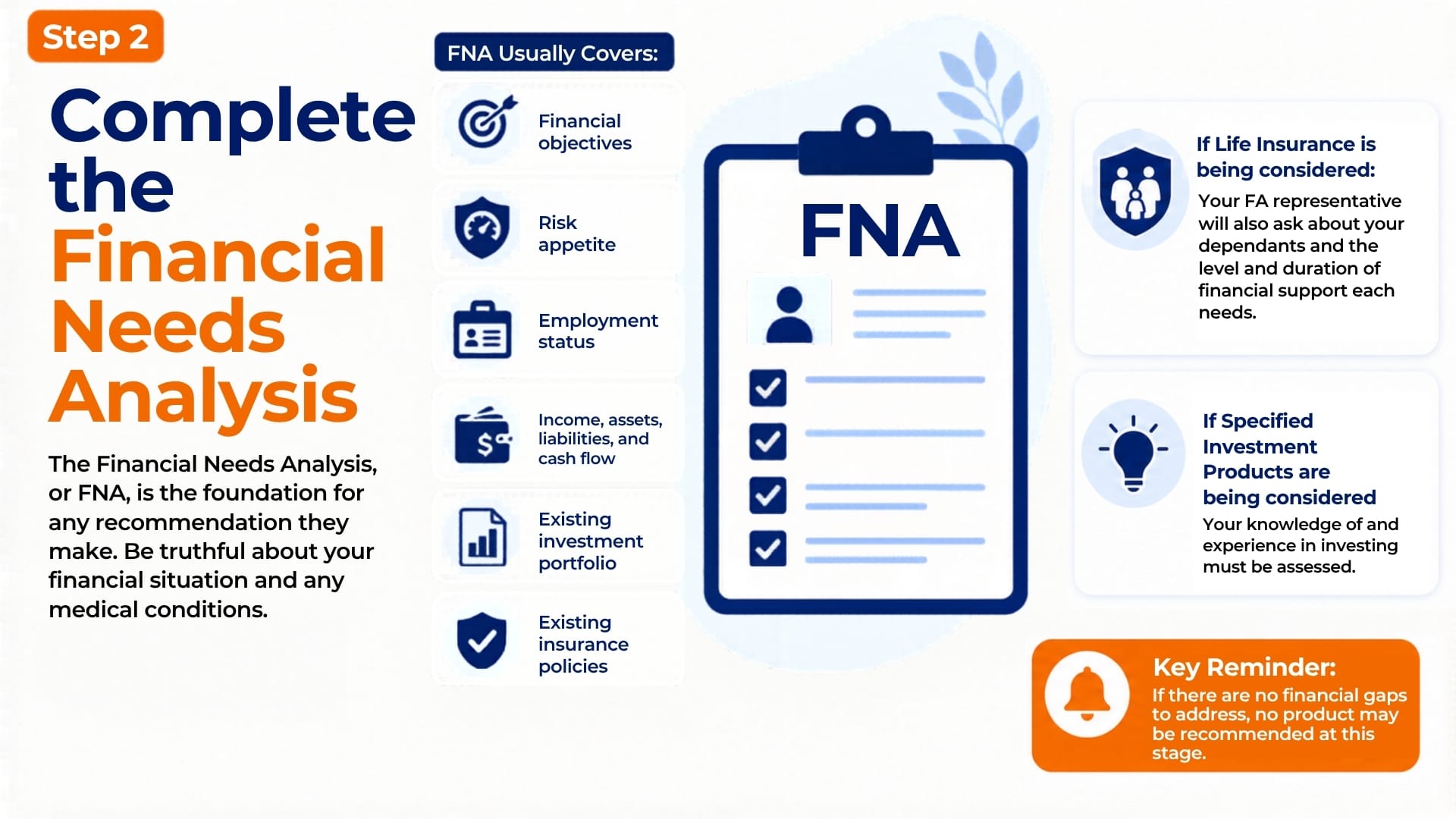
Your FA representative will gather information about your financial situation, goals, and needs. This fact-finding process is called an FNA — it is the foundation for any recommendation they make.
The FNA will typically cover:
Your financial objectives and risk appetite
Your employment status, income, assets, liabilities, and cash flow
Your existing investment portfolio and any insurance policies you hold
If you are considering buying life insurance, they will also ask about your dependants and the level and duration of financial support each needs.
Note: If you are using a digital advisory service with no human adviser, you may not need to provide all of the above. However, the same principle applies: the recommendations can only be as good as the information the system has about you.
If the recommendation includes a Specified Investment Product (SIP) — a complex product such as certain derivatives or structured products — your FA representative must also assess whether you have the relevant knowledge and experience before recommending it.
If they find no financial gaps to address, they may not recommend any product at this stage.
Step 3: The recommendation
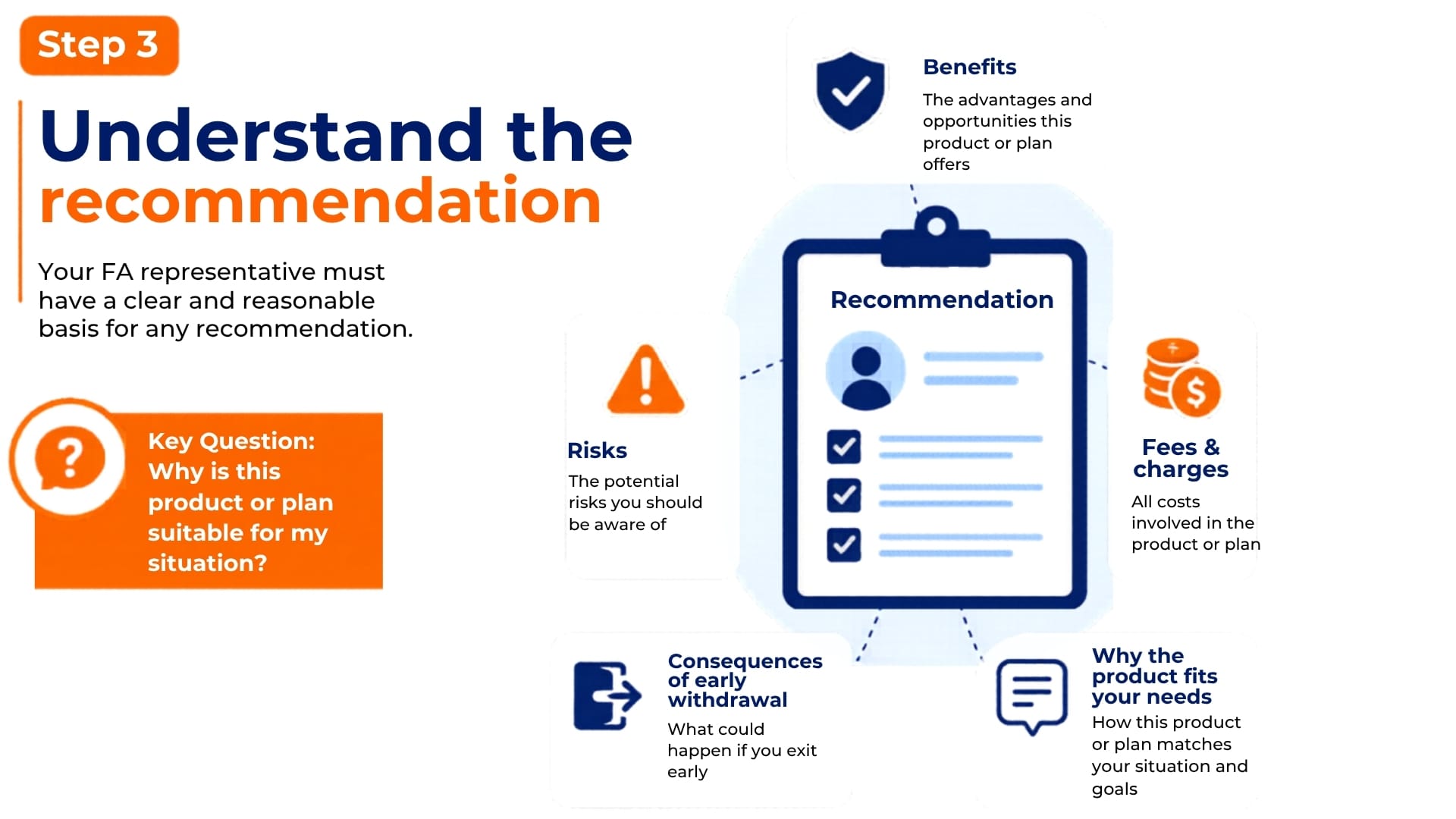
Your FA representative must have a clear and reasonable basis for any recommendation. They must:
Explain why the product or plan is suitable for your specific situation
Explain the product’s benefits, risks, fees and charges, and what happens if you withdraw early or surrender the policy or terminate the investment product
If you do not meet the knowledge requirements for a SIP — either through the Customer Knowledge Assessment for unlisted SIPs, or the Customer Account Review for listed SIPs — your FA representative cannot recommend that product to you. If you still choose to buy it, the responsibility for assessing its suitability shifts to you.
Step 4: Product documents you should receive
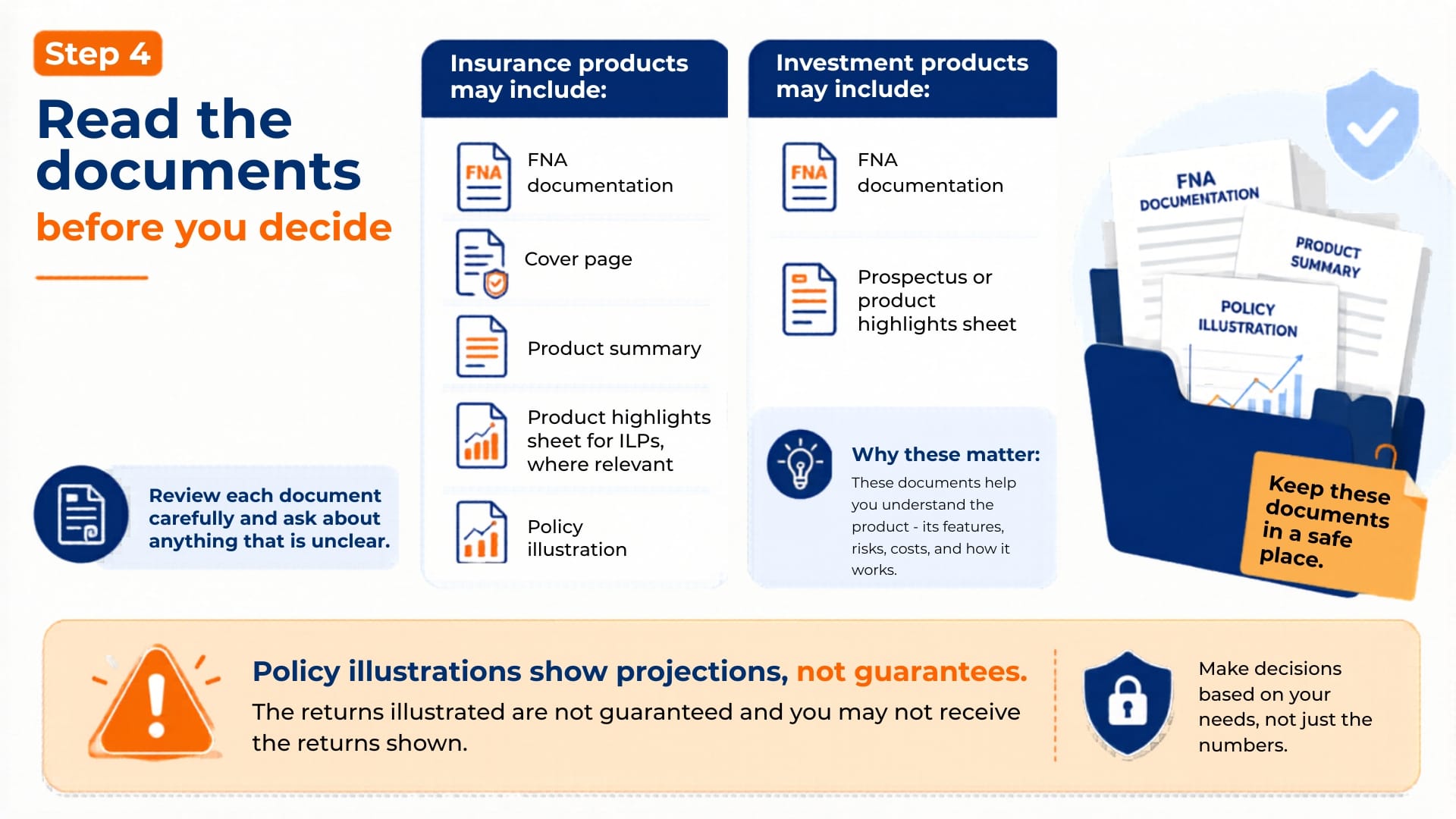
Before you decide, your FA representative must give you the full product documents. What you receive depends on the type of product:
For insurance products:
FNA documentation: Shows the information you provided and the basis of the recommendation
Cover page: A document highlighting key information from the policy illustration and product summary
Product summary: Overview of features, exclusions, limitations, fees, and charges
Product Highlights Sheet (for investment-linked policies – ILPs): This describes the key features and risks of the relevant sub-fund
Policy illustration: Shows benefits or projected amounts payable in a claim or early termination of the policy, and charges. Note: these are projections, not guarantees. You may not receive the returns shown.
For bundled insurance products, you may also receive a document comparing the bundled product with a similar term life insurance product.
For investment products:
FNA documentation: Similar to the insurance FNA
Prospectus or Product Highlights Sheet: Explains the product’s features, risks, and costs
Step 5: Ongoing review
A good FA representative will check in with you from time to time to review your policy or investment portfolio and see whether it continues to meet your needs. If your goals, income, or personal circumstances changes — for example, a new child, a job change, or difficulty keeping up with premiums — contact your FA representative rather than wait for the next scheduled review.
Your checklist: Before, during, and after
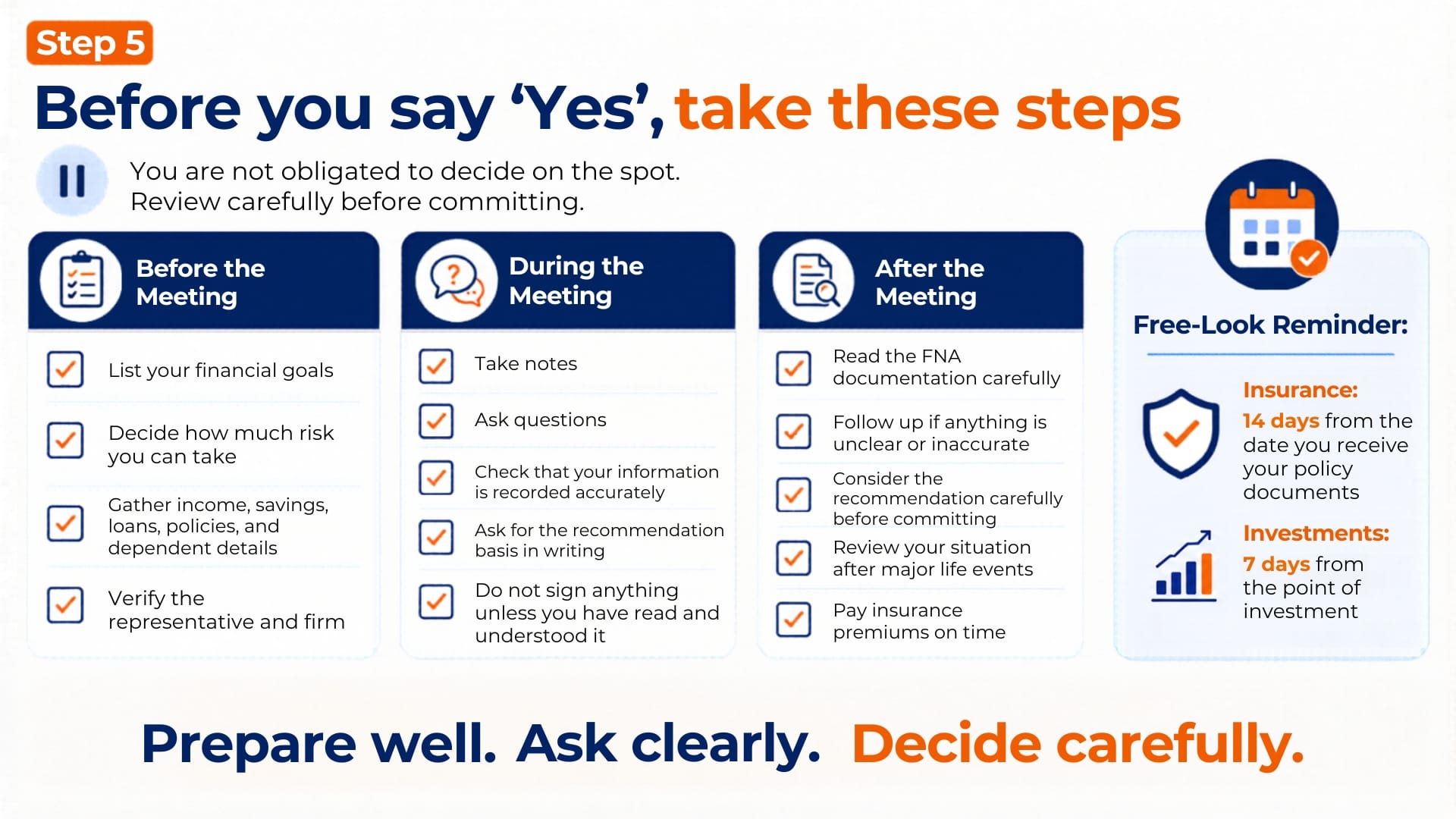
Before the meeting
List your financial goals: protection, savings, investment, or income.
Decide how much risk you are prepared and able to take. Could you afford to lose some or all of what you invest?
Gather your financial details: Income, savings, existing loans, current insurance policies, and details of any dependants.
Verify your FA representative’s credentials at eservices.mas.gov.sg/rr (opens in new tab) and the firm at eservices.mas.gov.sg/fid (opens in new tab).
During the meeting
Take notes of what is discussed.
Ask about anything you do not understand. Do not move on until it is clear.
Check that the information recorded about you is accurate, including your income, risk profile, and financial objectives.
Ask for the basis of the recommendation in writing. This record can help if a dispute arises later.
Ask about the free-look or cancellation period and what the process and costs are if you change your mind.
Do not sign anything unless you have read and understood it. You are not obligated to decide on the spot.
After the meeting
Read all FNA documentation carefully. Contact your FA representative if anything is inaccurate.
Consider the recommendation carefully before committing. Take as much time as you need.
Review your financial situation regularly — particularly after major life events such as marriage, birth of a child, or change in income.
Pay insurance premiums on time to avoid your policy lapsing.
If you change your mind: Free-look periods
Most products allow you to cancel within a free-look period after purchase:
Insurance: 14 days from the date you receive your policy documents
Investments: 7 days from the point of investment
You can cancel during the free-look period without extra fees, but if the investment has dropped in value, the refund may be lower than your original amount.
If you choose not to take up a recommended product and select a different one instead, it is your responsibility to ensure the alternative is suitable for your needs.
Watch out for
Providing incomplete or inaccurate information during the FNA. Your FA representative can only base their recommendation on what you tell them — if that picture is incomplete, the recommendation may not meet your needs.
Feeling pressured to sign on the spot. You are never obligated to buy immediately.
Assuming the policy illustration shows guaranteed returns. Illustrations are projections — actual returns will depend on market performance and product charges.
Your next steps
Before your next FA meeting, gather your income details, existing policies, and a written list of your financial goals.
Verify your FA representative’s credentials at eservices.mas.gov.sg/fid (opens in new tab) and eservices.mas.gov.sg/rr (opens in new tab) before the meeting.
During the meeting, ask for any recommendation and its basis to be confirmed in writing.
After the meeting, review all FNA documentation carefully and follow up if anything is unclear or inaccurate. Consider the recommendation carefully before committing.
Review your financial situation regularly — particularly after major life events such as marriage, birth of a child, or change in income.
For an overview on the financial advisory process in Singapore
Frequently asked questions (FAQ)
What is a Financial Needs Analysis (FNA) and why is it required?
An FNA is a fact-finding process your FA representative must complete before making any recommendation. It covers your financial objectives, risk appetite, employment status, income, assets, liabilities, and existing policies. This information forms the basis of any recommendation. The quality of the recommendation depends directly on the accuracy and completeness of what you disclose — provide complete, honest information.
What documents should I receive when buying insurance?
For insurance, you must receive: FNA documentation (the basis of the recommendation); a cover page (key information from the policy illustration); a product summary (features, exclusions, limitations, fees); a Product Highlights Sheet (for Investment-Linked Policies); and a policy illustration (projected benefits and charges). Note: Illustrations are projections, not guarantees. If you do not receive these documents, make sure to request for them from your FA representative, or consult another FA representative.
What is the free-look period for investments and insurance in Singapore?
The free-look period is the window within which you can cancel a product after purchase. For insurance, this is 14 days from the date you receive your policy documents. For investments, it is 7 days from the point of investment. You can cancel without administrative penalty, but you bear any market loss if the fund or product has fallen in value during that period.
Can an FA representative recommend a Specified Investment Product (SIP) to me?
Not automatically. For unlisted SIPs, you must pass the Customer Knowledge Assessment first. For listed SIPs, your broker must conduct a Customer Account Review. If you have not met these requirements, your FA representative cannot recommend an SIP. If you want to buy one, the responsibility for assessing suitability shifts entirely to you.
What should I do if an FA representative's recommendation does not feel right?
You are never obligated to buy any product. Ask your FA representative to explain why it is suitable for you specifically, and ask whether there are alternatives. Take the documents home before deciding. If you disagree with the recommendation, say so clearly — the FA representative should offer alternatives. If you decide to buy a different product on your own, you are responsible for verifying its suitability.
What should I do after buying an insurance or investment product?
Review all FNA documentation to confirm it accurately reflects your situation. Contact your FA representative if anything is incorrect. Pay insurance premiums on time to prevent a policy lapse. Review your portfolio or policy whenever your circumstances change, rather than wait for a scheduled review.
Related articles
Financial advice: Who you could be dealing with
There are different types of MAS-regulated financial advisers in Singapore—tied agents, independent advisers, and robo-advisers. Learn what suits you and how to verify credentials.
What to ask when buying an investment product
Never let enthusiasm replace due diligence. Use this essential checklist—covering fees, risks, liquidity, and adviser credentials—before putting your money into any investment product.
Putting together an investment portfolio
A good portfolio doesn’t manage itself. Learn how to diversify, allocate assets, rebalance strategically, and keep your Singapore investments aligned with your real financial goals.